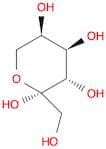
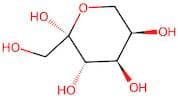
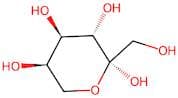
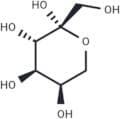
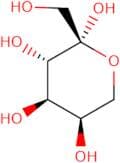
CAS 7660-25-5
:D(-)-Fructose
Description:
It appears there is a mix-up with the CAS number provided. D(-)-Fructose, a simple sugar and a ketonic monosaccharide, is typically associated with the CAS number 57-48-7. This carbohydrate is known for its sweet taste and is commonly found in many fruits and honey. D(-)-Fructose is a hexose, meaning it contains six carbon atoms, and it exists in both open-chain and cyclic forms, with the cyclic form being predominant in solution. It is soluble in water and has a high glycemic index, making it a quick source of energy. Fructose is also a key component of sucrose, which is table sugar, and is often used in food products as a sweetener. In terms of its chemical properties, D(-)-Fructose can undergo fermentation and is metabolized differently than glucose, primarily through the liver. It is important in various biochemical pathways and has implications in health, particularly concerning its consumption and effects on metabolism.
Formula:C6H12O6
InChI:InChI=1/C6H12O6/c7-1-3-4(9)5(10)6(11,2-8)12-3/h3-5,7-11H,1-2H2/t3-,4-,5+,6?/m1/s1
InChI key:InChIKey=LKDRXBCSQODPBY-ARQDHWQXSA-N
SMILES:C(O)[C@]1(O)[C@@H](O)[C@H](O)[C@H](O)CO1
Synonyms:- Arabino-hexulose
- D-(-)-Fructose for analysis
- D-Levulose
- D-fructofuranose
- Fructopyranose
- Fructopyranose, β-<span class="text-smallcaps">D</span>-
- Fructose
- Fructose, Pure
- Fruit sugar
- Frutabs
- HPC
- Laevoral
- Laevosan
- Levugen
- b-D-Fructose (1.04007)
- beta-D-fructopyranose
- β-<span class="text-smallcaps">D</span>-Fructopyranose
- See more synonyms
Sort by
Purity (%)
0
100
|
0
|
50
|
90
|
95
|
100
Found 7 products.
Fructose
CAS:Fructose (Fructopyranose) is a simple ketonic monosaccharide extracted from Honey,fruits,berries,melon.Formula:C6H12O6Purity:99.80% - 99.83%Color and Shape:White Crystalline PowderMolecular weight:180.16Fructose
CAS:Fructose is a monosaccharide that can be found in many fruits, honey, and some vegetables. It has been shown to have pathogenic effects on the kidney by causing tubulointerstitial injury. This damage may be due to the degradation of fructose by sorbitol dehydrogenase into hydrogen fluoride, which inhibits cell respiration and increases oxidative stress. Fructose also binds to bcl-2 protein and glycol ethers, which may lead to apoptosis.Formula:C6H12O6Purity:Min. 95%Molecular weight:180.16 g/mol