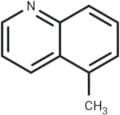
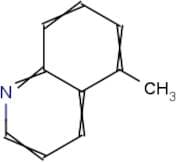
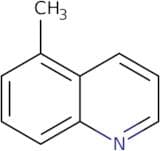
CAS 7661-55-4
:5-Methylquinoline
Description:
5-Methylquinoline is a heterocyclic aromatic compound characterized by a fused ring structure that includes a quinoline core with a methyl group attached at the fifth position. It has a molecular formula of C10H9N and features a nitrogen atom within its bicyclic framework, contributing to its basicity and potential for forming coordination complexes. This compound is typically a yellowish liquid or solid at room temperature and exhibits a distinctive aromatic odor. 5-Methylquinoline is soluble in organic solvents such as ethanol and ether but has limited solubility in water. It is used in various applications, including as a building block in organic synthesis, in the production of dyes, and as a potential ligand in coordination chemistry. Additionally, it may exhibit biological activity, making it of interest in pharmaceutical research. Safety precautions should be taken when handling this compound, as it may pose health risks if inhaled or ingested.
Formula:C10H9N
InChI:InChI=1/C10H9N/c1-8-4-2-6-10-9(8)5-3-7-11-10/h2-7H,1H3
InChI key:InChIKey=LMYVCXSKCQSIEQ-UHFFFAOYSA-N
SMILES:CC=1C2=C(C=CC1)N=CC=C2
Synonyms:- Brn 0111321
- Quinoline, 5-methyl-
- 5-Methylquinoline
- 5-20-07-00399 (Beilstein Handbook Reference)
- 5-Methylquinoline ISO 9001:2015 REACH
Sort by
Purity (%)
0
100
|
0
|
50
|
90
|
95
|
100
Found 4 products.
5-Methylquinoline
CAS:5-Methylquinoline is a quinoline derivative widely used in biochemical experiments and drug synthesis research.Formula:C10H9NPurity:99.84%Color and Shape:SolidMolecular weight:143.195-Methylquinoline
CAS:5-Methylquinoline is a quinoline derivative that is used in the synthesis of other quinoline derivatives. It can be synthesized from cinnamaldehyde, which can be obtained from cinnamic acid or benzaldehyde. 5-Methylquinoline has been shown to have antioxidant properties and inhibit colorectal carcinoma cells in vitro. The compound also inhibits the growth of caco-2 cells. One isomer of 5-methylquinoline, ethenyl, has been shown to cause a shift in the spectrum of light absorbed by caco-2 cells.
Formula:C10H9NPurity:Min. 95%Molecular weight:143.18 g/mol