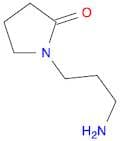
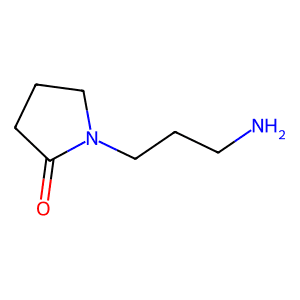
CAS 7663-77-6
:1-(3-Aminopropyl)-2-pyrrolidinone
- N-(3-Aminopropyl)-2-pyrrolidinone
- N-(3-Aminopropyl)-γ-butyrolactam
- N-(3-Aminopropyl)-2-pyrrolidone
- 1-(3-Aminopropyl)-2-pyrrolidinone
- 2-Pyrrolidinone, 1-(3-aminopropyl)-
1-(3-Aminopropyl)pyrrolidin-2-one
CAS:Formula:C7H14N2OPurity:95%Color and Shape:LiquidMolecular weight:142.19891-(3-Aminoprop-1-yl)pyrrolidin-2-one
CAS:1-(3-Aminoprop-1-yl)pyrrolidin-2-oneFormula:C7H14N2OPurity:95%Color and Shape: yellow liquidMolecular weight:142.20g/molN-(3′-Aminopropyl)-2-pyrrolidone
CAS:Formula:C7H14N2OPurity:95%Color and Shape:LiquidMolecular weight:142.2021-(3-Aminopropyl)-2-pyrrolidinone
CAS:1-(3-Aminopropyl)-2-pyrrolidinone is a chemical compound that has been used as a chemotherapeutic treatment for heart disease and polyamine oxidase deficiency. The compound has also been shown to have a direct effect on the synthesis of fatty acids in the body, which may lead to the development of new treatments for diabetes. 1-(3-Aminopropyl)-2-pyrrolidinone can be formulated into conjugates with other molecules, such as chloride ions or fatty acids, in order to target specific cells or tissues. This method of delivery is efficient and has been shown to be able to cross the blood-brain barrier. 1-(3-Aminopropyl)-2-pyrrolidinone is an amino acid derivative that contains an aminoguanidine functional group. Aminoguanidine inhibits polyamine oxidase activity in vitro by reacting with the carbonyl group at position C
Formula:C7H14N2OPurity:Min. 95%Color and Shape:Colorless Clear LiquidMolecular weight:142.2 g/mol