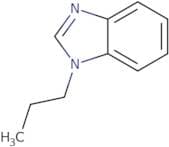
CAS 7665-66-9
:1-propyl-1H-benzimidazole
Description:
1-Propyl-1H-benzimidazole is an organic compound characterized by its benzimidazole core, which consists of a fused benzene and imidazole ring. This compound features a propyl group attached to the nitrogen atom of the imidazole ring, influencing its solubility and reactivity. Typically, benzimidazole derivatives exhibit a range of biological activities, including antifungal, antibacterial, and anticancer properties, making them of interest in pharmaceutical research. The presence of the propyl group can enhance lipophilicity, potentially affecting the compound's pharmacokinetics. In terms of physical properties, 1-propyl-1H-benzimidazole is likely to be a solid at room temperature, with moderate melting and boiling points typical of similar organic compounds. Its chemical behavior may include participation in various reactions, such as nucleophilic substitutions or electrophilic aromatic substitutions, depending on the conditions. Safety data should be consulted for handling and exposure guidelines, as with any chemical substance. Overall, 1-propyl-1H-benzimidazole represents a versatile structure in organic chemistry with potential applications in medicinal chemistry.
Formula:C10H12N2
InChI:InChI=1/C10H12N2/c1-2-7-12-8-11-9-5-3-4-6-10(9)12/h3-6,8H,2,7H2,1H3
SMILES:CCCn1cnc2ccccc12
Synonyms:- 1H-Benzimidazole, 1-propyl-
- 1-Propyl-1H-benzoimidazole
- 1-Propyl-1H-benzimidazole
Sort by
Purity (%)
0
100
|
0
|
50
|
90
|
95
|
100
Found 1 products.
1-Propyl-1H-1,3-benzodiazole
CAS:<p>1-Propyl-1H-1,3-benzodiazole is a nitro derivative of the benzimidazole compounds. It is used in the preparation of azo dyes and as a dye intermediate. 1-Propyl-1H-1,3-benzodiazole is metabolized through oxidative or reductive pathways to form reactive intermediates that bind to DNA and protein substrates. This compound also inhibits fatty acid synthesis by forming ternary complexes with enzyme acyl carrier protein (ACP) and coenzyme A (CoA). The metabolism of 1-propyl-1H-1,3-benzodiazole leads to the formation of reactive metabolites that can cause congestive heart failure in mammals.</p>Formula:C10H12N2Purity:Min. 95%Molecular weight:160.22 g/mol