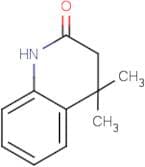
CAS 76693-04-4
:2(1H)-Quinolinone, 3,4-dihydro-4,4-dimethyl-
Description:
2(1H)-Quinolinone, 3,4-dihydro-4,4-dimethyl- (CAS 76693-04-4) is a chemical compound characterized by its quinolinone structure, which features a bicyclic system composed of a benzene ring fused to a pyridine ring. This compound typically exhibits a pale yellow to light brown appearance and is soluble in organic solvents. Its molecular structure includes a dihydroquinolinone framework, which contributes to its potential biological activity. The presence of the dimethyl groups at the 4-position enhances its lipophilicity, potentially influencing its interaction with biological targets. This compound may be of interest in medicinal chemistry due to its structural similarity to various bioactive molecules. Additionally, it may exhibit properties such as fluorescence or photostability, making it useful in certain applications. As with many organic compounds, its reactivity can be influenced by the functional groups present, and it may participate in various chemical reactions, including nucleophilic substitutions or cyclization processes. Safety data should be consulted for handling and usage, as with all chemical substances.
Formula:C11H13NO
Sort by
Purity (%)
0
100
|
0
|
50
|
90
|
95
|
100
Found 3 products.
4,4-Dimethyl-1,3-dihydroquinolin-2-one
CAS:4,4-Dimethyl-1,3-dihydroquinolin-2-onePurity:98%Molecular weight:175.23g/mol4,4-Dimethyl-1,3-dihydroquinolin-2-one
CAS:4,4-Dimethyl-1,3-dihydroquinolin-2-one is a heterocyclic compound that has been shown to be cytotoxic to cancer cells. It is also an inhibitor of cytochrome P450 and has been shown to induce blood pressure in rat models. This drug is synthesized by the reaction of 4,4-dimethylquinoline with chloroform in the presence of sodium hydroxide. 4,4-Dimethyl-1,3-dihydroquinolin-2-one is reactive and can undergo nucleophilic attack on chlorides or other nucleophiles at either nitrogen atom. This process can lead to tautomerization between two possible tautomers that differ in configuration at the double bond. The product of this reaction is an oxime.Formula:C11H13NOPurity:Min. 95%Molecular weight:175.23 g/mol