CAS 769-56-2
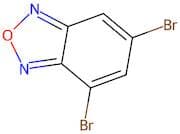
:2,1,3-Benzoxadiazole, 4,6-dibromo-
Description:
2,1,3-Benzoxadiazole, 4,6-dibromo- is a heterocyclic organic compound characterized by its fused benzene and oxadiazole rings, which contribute to its unique chemical properties. The presence of bromine substituents at the 4 and 6 positions enhances its reactivity and can influence its electronic properties, making it useful in various applications, including as a fluorescent probe or in organic electronics. This compound typically exhibits good thermal stability and solubility in organic solvents, which is advantageous for its use in synthetic processes. Its structure allows for potential interactions with biological systems, making it of interest in medicinal chemistry. Additionally, the compound may display photophysical properties, such as fluorescence, which can be exploited in imaging and sensing applications. Safety data indicates that, like many brominated compounds, it should be handled with care due to potential toxicity and environmental concerns. Overall, 2,1,3-Benzoxadiazole, 4,6-dibromo- is a versatile compound with significant implications in both research and industrial applications.
Formula:C6H2Br2N2O
Sort by
Purity (%)
0
100
|
0
|
50
|
90
|
95
|
100
Found 4 products.
4,6-Dibromobenzo[c][1,2,5]oxadiazole
CAS:Formula:C6H2Br2N2OPurity:95%Color and Shape:SolidMolecular weight:277.90094,6-Dibromo-2,1,3-benzoxadiazole
CAS:4,6-Dibromo-2,1,3-benzoxadiazolePurity:95%Molecular weight:277.90g/mol4,6-Dibromo-2,1,3-benzoxadiazole
CAS:4,6-Dibromo-2,1,3-benzoxadiazole is an azide compound that is used as a precursor for the synthesis of other compounds. The structure of this molecule consists of two benzene rings with a single oxygen atom in between. It contains four bromine atoms and one fluorine atom. This molecule has an isomeric relationship to 2,1,3-benzoxyazetidine and 2,1,3-benzothiadiazetidine because it has two identical groups on each ring. 4,6-Dibromo-2,1,3-benzoxadiazole can be synthesized by reacting phenols with sodium azide or fluorine atoms in the presence of a catalytic amount of copper(II) chloride.
Formula:C6H2Br2N2OPurity:Min. 95%Molecular weight:277.9 g/mol
![4,6-Dibromobenzo[c][1,2,5]oxadiazole](/_next/image/?url=https%3A%2Fstatic.cymitquimica.com%2Fproducts%2FIN%2Fthumb%2FDA00G7WK.jpg&w=3840&q=75)