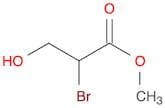
CAS 7691-28-3
:methyl-2-bromo-3-hydroxypropanoate
Description:
Methyl-2-bromo-3-hydroxypropanoate, with the CAS number 7691-28-3, is an organic compound characterized by its ester functional group, a bromine atom, and a hydroxyl group. This compound typically appears as a colorless to pale yellow liquid and is soluble in organic solvents. Its molecular structure includes a three-carbon backbone, with a bromine atom attached to the second carbon and a hydroxyl group on the third carbon, contributing to its reactivity. The presence of the bromine atom makes it a potential electrophile, which can participate in various nucleophilic substitution reactions. The hydroxyl group provides the compound with the ability to engage in hydrogen bonding, influencing its physical properties and reactivity. Methyl-2-bromo-3-hydroxypropanoate can be utilized in organic synthesis, particularly in the preparation of more complex molecules. As with many brominated compounds, it is essential to handle it with care due to potential toxicity and environmental concerns. Proper safety measures should be observed when working with this substance in a laboratory setting.
Sort by
Purity (%)
0
100
|
0
|
50
|
90
|
95
|
100
Found 4 products.
(S)-methyl-2-bromo-3-hydroxypropanoate
CAS:Formula:C4H7BrO3Purity:95%Color and Shape:LiquidMolecular weight:183.0006Methyl 2-bromo-3-hydroxypropanoate
CAS:Methyl 2-bromo-3-hydroxypropanoatePurity:95%Molecular weight:183.00g/molMethyl 2-bromo-3-hydroxypropanoate
CAS:Formula:C4H7BrO3Purity:95%Color and Shape:LiquidMolecular weight:183.001Methyl 2-bromo-3-hydroxypropanoate
CAS:Methyl 2-bromo-3-hydroxypropanoate is a linear molecule that can be used to produce polymers and copolymers. This compound is polymerized with other monomers to form poly(methyl 2-bromo-3-hydroxypropanoate) (PMBH). It can also be used as a crosslinker in the production of polyurethane. Methyl 2-bromo-3-hydroxypropanoate can be made by reacting sodium carbonate, chloride, and trifluoride with methyl 3-methoxypropanoate. The reaction produces an intermediate that is then reacted with bromine gas to yield methyl 2-bromo-3-hydroxypropanoate.
Methyl 2-bromo-3-hydroxypropanoate is biodegradable and has been shown to have low toxicity. It has been used in a number of biomedical applications such asFormula:C4H7BrO3Purity:Min. 95%Molecular weight:183 g/mol