CAS 769132-76-5
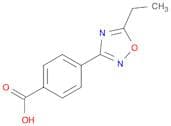
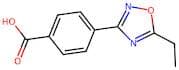
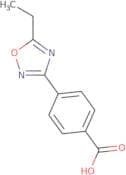
:4-(5-Ethyl-1,2,4-oxadiazol-3-yl)benzoic acid
Description:
4-(5-Ethyl-1,2,4-oxadiazol-3-yl)benzoic acid is an organic compound characterized by its unique structure, which includes a benzoic acid moiety and a 1,2,4-oxadiazole ring. The presence of the ethyl group on the oxadiazole enhances its lipophilicity, potentially influencing its solubility and biological activity. This compound typically exhibits properties such as moderate to high melting points, depending on its crystalline form, and may show varying solubility in polar and non-polar solvents. The oxadiazole ring is known for its stability and can participate in various chemical reactions, making this compound of interest in medicinal chemistry and material science. Additionally, the carboxylic acid functional group in benzoic acid contributes to its acidity and potential reactivity, allowing for further derivatization. Overall, 4-(5-Ethyl-1,2,4-oxadiazol-3-yl)benzoic acid is a versatile compound with potential applications in pharmaceuticals and agrochemicals, warranting further investigation into its properties and uses.
Formula:C11H10N2O3
InChI:InChI=1S/C11H10N2O3/c1-2-9-12-10(13-16-9)7-3-5-8(6-4-7)11(14)15/h3-6H,2H2,1H3,(H,14,15)
InChI key:InChIKey=FKTMJZFSKHVEBY-UHFFFAOYSA-N
SMILES:C(C)C1=NC(=NO1)C2=CC=C(C(O)=O)C=C2
Synonyms:- Benzoic acid, 4-(5-ethyl-1,2,4-oxadiazol-3-yl)-
- 4-(5-Ethyl-1,2,4-oxadiazol-3-yl)benzoic acid
Sort by
Purity (%)
0
100
|
0
|
50
|
90
|
95
|
100
Found 4 products.
Benzoic acid, 4-(5-ethyl-1,2,4-oxadiazol-3-yl)- (9CI)
CAS:Formula:C11H10N2O3Purity:97%Color and Shape:SolidMolecular weight:218.20874-(5-Ethyl-1,2,4-oxadiazol-3-yl)benzoic acid
CAS:4-(5-Ethyl-1,2,4-oxadiazol-3-yl)benzoic acidPurity:97%Molecular weight:218.21g/mol4-(5-Ethyl-1,2,4-oxadiazol-3-yl)benzoic acid
CAS:Formula:C11H10N2O3Purity:97%Molecular weight:218.2124-(5-Ethyl-1,2,4-oxadiazol-3-yl)benzoic acid
CAS:4-(5-Ethyl-1,2,4-oxadiazol-3-yl)benzoic acid (ETOA) is a monocarboxylic acid that has been shown to be an effective electron donor in the oxidation of fatty acids. ETOA reacts with ammonium nitrate and sodium carbonate to form nanowires with hydrochloric acid as the carbon source. These wires were found to have optical properties that are similar to those of silicon and exhibit increased electrical conductivity when compared to other metals such as copper. ETOA has also been shown to chelate metal ions such as molybdenum.
Formula:C11H10N2O3Purity:Min. 95%Molecular weight:218.21 g/molRef: 3D-UFB13276
Discontinued product