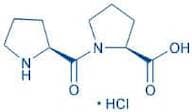
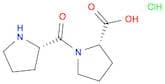
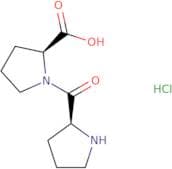
CAS 76932-06-4
:H-Pro-Pro-OH . HCl
Description:
H-Pro-Pro-OH·HCl, also known as Prolyl-Proline Hydrochloride, is a dipeptide derivative composed of two proline amino acids linked by a peptide bond, with a hydroxyl group and a hydrochloride salt form. This compound is characterized by its unique cyclic structure due to the presence of proline, which introduces rigidity and influences its conformational properties. It is typically a white to off-white crystalline powder, soluble in water, and exhibits a specific melting point range. The hydrochloride form enhances its solubility and stability in aqueous solutions, making it suitable for various biochemical applications. H-Pro-Pro-OH·HCl is often studied for its potential roles in peptide synthesis, as well as its implications in biological systems, such as influencing protein folding and stability. Additionally, it may have applications in pharmaceuticals and research, particularly in studies related to peptide interactions and modifications. As with many peptides, its biological activity can be influenced by factors such as concentration, pH, and the presence of other ions or molecules.
Formula:C10H16N2O3.HCl
Sort by
Purity (%)
0
100
|
0
|
50
|
90
|
95
|
100
Found 4 products.
H-Pro-Pro-OH · HCl
CAS:Bachem ID: 4000217.
Formula:C10H16N2O3·HClPurity:> 99%Color and Shape:White PowderMolecular weight:248.71H-Pro-Pro-OH·HCl
CAS:H-Pro-Pro-OH·HCl is a fine chemical that is commonly used as a building block for organic synthesis. This compound is soluble in water, making it an ideal reactant for use in reactions involving peptides and proteins. H-Pro-Pro-OH·HCl is also useful as an intermediate, research chemical, or speciality chemical. It has been used as a reagent for the preparation of other chemicals and has shown high quality performance in reactions with nucleophiles.Formula:C10H16N2O3·HClPurity:Min. 95%Color and Shape:White PowderMolecular weight:248.71 g/mol