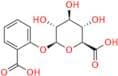
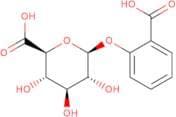
CAS 7695-70-7
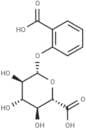
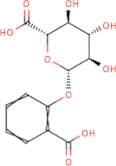
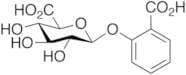
:Salicylic acid phenolic glucuronide
- 2-Carboxyphenyl β-D-glucopyranosiduronic acid
- Glucopyranosiduronic acid, o-carboxyphenyl, β-D-
- β-D-Glucopyranosiduronic acid, o-carboxyphenyl
- Salicyl phenolic glucuronide
- β-D-Glucopyranosiduronic acid, 2-carboxyphenyl
1-Salicylate Glucuronide
CAS:1-Salicylate Glucuronide (Salicylic Acid b-D-O-Glucuronide) is a metabolite of salicylic acid after glucuronidation, promoting excretion.
Formula:C13H14O9Color and Shape:SolidMolecular weight:314.25Salicylic Acid Phenolic β-D-Glucuronide
CAS:Formula:C13H14O9Color and Shape:White To Off-White SolidMolecular weight:314.25Salicylic acid phenolic D-glucuronide
CAS:Formula:C13H14O9Purity:≥ 95%Color and Shape:White to off-white solidMolecular weight:314.24Salicylic Acid beta-D-O-Glucuronide
CAS:Controlled ProductApplications Salicylic Acid β-D-O-Glucuronide is a metabolite of Acetylsalicylic Acid (Aspirin) (A187780).
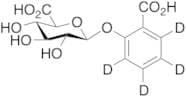
References Grootveld, M., et al.: Biochem. Pharmacol., 37, 271 (1988), Subbegowda, R., et al.: Cancer Res., 58, 2772 (1998), Yoshida, Y., et al.: Eur. J. Pharmacol., 349, 49 (1998),Formula:C13H14O9Color and Shape:NeatMolecular weight:314.24Salicylic Acid B-D-O-Glucuronide-d4
CAS:Controlled ProductFormula:C13D4H10O9Color and Shape:NeatMolecular weight:318.269Salicylic acid D-glucuronide
CAS:Salicylic acid D-glucuronide is the major metabolite of aspirin, which is formed by hydrolysis of acetylsalicylic acid. It has been demonstrated to have anti-inflammatory and analgesic effects. Salicylic acid D-glucuronide is excreted in urine and can be detected in human serum. The formation rate of this metabolite varies with the individual's age, sex, and kidney function.
Salicylic acid D-glucuronide can be formed in vitro using hydrochloric acid and acetylsalicylic acid as substrates. This reaction is catalyzed by the enzyme uridine diphosphate glucuronyltransferase (UGT). Salicylic acid D-glucuronide has been shown to form covalent adducts with hydroxyl groups from other molecules in vivo and in vitro, including proteins (e.g., albumin) and DNA bases (e.g.,Formula:C13H14O9Purity:Min. 95%Color and Shape:PowderMolecular weight:314.24 g/molRef: 3D-MS09950
Discontinued product