![N-[(3S,6R)-4,6-dihydroxy-5-methoxy-2-methyl-tetrahydropyran-3-yl]-3-hydroxy-3-methyl-butanamide](/_next/image/?url=https%3A%2Fstatic.cymitquimica.com%2Fcas-image%2Fthumb-webp%2F302888-n-3s-6r-46-dihydroxy-5-methoxy-2-methyl-tetrahydropyran-3-yl-3-hydroxy-3-methyl-butanamide.webp&w=3840&q=75)
CAS 769959-88-8
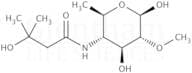
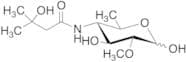
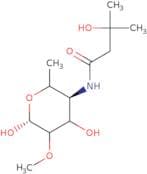
:N-[(3S,6R)-4,6-dihydroxy-5-methoxy-2-methyl-tetrahydropyran-3-yl]-3-hydroxy-3-methyl-butanamide
Description:
N-[(3S,6R)-4,6-dihydroxy-5-methoxy-2-methyl-tetrahydropyran-3-yl]-3-hydroxy-3-methyl-butanamide is a complex organic compound characterized by its specific stereochemistry and functional groups. This substance features a tetrahydropyran ring, which contributes to its cyclic structure and potential biological activity. The presence of multiple hydroxyl groups indicates that it may exhibit strong hydrogen bonding capabilities, influencing its solubility and reactivity. The methoxy group adds to its structural diversity, potentially affecting its interaction with biological targets. As an amide, it may also participate in various chemical reactions typical of amides, such as hydrolysis or acylation. The compound's stereochemistry, particularly the (3S,6R) configuration, suggests that it may have specific interactions in biological systems, possibly influencing its pharmacological properties. Overall, this compound's unique structure and functional groups position it as a candidate for further study in medicinal chemistry and related fields.
Formula:C12H23NO6
InChI:InChI=1/C12H23NO6/c1-6-8(13-7(14)5-12(2,3)17)9(15)10(18-4)11(16)19-6/h6,8-11,15-17H,5H2,1-4H3,(H,13,14)/t6?,8-,9?,10?,11-/m1/s1
SMILES:CC1[C@H](C(C([C@H](O)O1)OC)O)N=C(CC(C)(C)O)O
Sort by
Purity (%)
0
100
|
0
|
50
|
90
|
95
|
100
Found 3 products.
Anthrose
CAS:Controlled ProductApplications Anthrose (cas# 769959-88-8) is a compound useful in organic synthesis.
References Saksena, R., et al.: Carbohydrate Research, 340, 1591 (2005)Formula:C12H23NO6Color and Shape:NeatMolecular weight:277.31Anthrose
CAS:Anthrose is a natural product that has been isolated from the larvae of Galleria mellonella, an insect. It has been shown to have antiviral activity against anthracis, a bacterium that causes anthrax. Anthrose treatment leads to cell lysis and DNA degradation in both prokaryotic and eukaryotic cells. The mechanism of action of this compound is not yet known, but it may be due to its ability to act as a competitive inhibitor for the enzyme aminotransferase activity. It also has antimicrobial properties and has been shown to inhibit Mycobacterium tuberculosis growth.Formula:C12H23NO6Purity:Min. 95%Color and Shape:PowderMolecular weight:277.31 g/mol