CAS 77123-56-9
:3-Ethynylbenzaldehyde
Description:
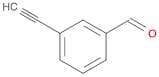
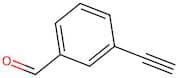
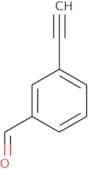
3-Ethynylbenzaldehyde, with the CAS number 77123-56-9, is an organic compound characterized by the presence of both an ethynyl group and an aldehyde functional group attached to a benzene ring. Its molecular structure features a phenyl ring substituted at the 3-position with an ethynyl group (–C≡C–) and at the 1-position with an aldehyde group (–CHO). This compound is typically a colorless to pale yellow liquid with a distinct aromatic odor. It is known for its reactivity due to the presence of the aldehyde functional group, which can participate in various chemical reactions, including nucleophilic additions and condensation reactions. Additionally, the ethynyl group contributes to its potential use in organic synthesis, particularly in the formation of more complex molecules through coupling reactions. 3-Ethynylbenzaldehyde is utilized in the synthesis of pharmaceuticals, agrochemicals, and other fine chemicals, making it a valuable compound in both academic and industrial chemistry.
Formula:C9H6O
InChI:InChI=1S/C9H6O/c1-2-8-4-3-5-9(6-8)7-10/h1,3-7H
InChI key:InChIKey=IGIUWNVGCVCNPV-UHFFFAOYSA-N
SMILES:C(#C)C1=CC(C=O)=CC=C1
Synonyms:- 3-Ethinylbenzaldehyd
- 3-Formylphenylacetylene
- Benzaldehyde, 3-Ethynyl-
- m-Ethynylbenzaldehyde
- 3-ETHYNYLBENZALDEHYDE
- 3-Ethynylbenzaldehyde
Sort by
Purity (%)
0
100
|
0
|
50
|
90
|
95
|
100
Found 4 products.
3-Ethynylbenzaldehyde
CAS:3-EthynylbenzaldehydeFormula:C9H6OPurity:97%Color and Shape: light yellow to yellow solidMolecular weight:130.14g/mol3-Ethynylbenzaldehyde
CAS:3-Ethynylbenzaldehyde is a tryptic, nitro compound that contains terminal alkynes and has functional groups. The functional theory of this compound suggests that it may be used as a chemosensor for the detection of acidic compounds. 3-Ethynylbenzaldehyde reacts with sodium trifluoroacetate to form an aldehyde, which is then oxidized to an acid by the addition of water. This acid can be detected using NMR spectroscopy. 3-Ethynylbenzaldehyde has been shown to react with sodium trifluoroacetate in solid form at room temperature and above. The resulting product is a yellow crystalline solid that can be identified by its UV spectrum.
Formula:C9H6OPurity:Min. 95%Color and Shape:PowderMolecular weight:130.14 g/mol