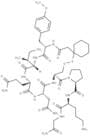
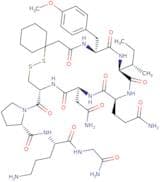
![1-{[(10S,13S,16S,22S)-13-(2-amino-2-oxoethyl)-16-(3-amino-3-oxopropyl)-19-[(2S)-butan-2-yl]-22-(4-…](/_next/image/?url=https%3A%2Fstatic.cymitquimica.com%2Fcas-image%2Fthumb-webp%2F42892-1-10s-13s-16s-22s-13-2-amino-2-oxoethyl-16-3-amino-3-oxopropyl-19-2s-butan-2-yl-22-4-methoxybenzyl-1215182124-pentaoxo-78-dithia-1114172023-pentaazaspiro-5-19-pentacos-10-yl-carbonyl-l-prolyl-l-ornithylglycinamide.webp&w=3840&q=75)
CAS 77327-45-8
:1-{[(10S,13S,16S,22S)-13-(2-amino-2-oxoethyl)-16-(3-amino-3-oxopropyl)-19-[(2S)-butan-2-yl]-22-(4-methoxybenzyl)-12,15,18,21,24-pentaoxo-7,8-dithia-11,14,17,20,23-pentaazaspiro[5.19]pentacos-10-yl]carbonyl}-L-prolyl-L-ornithylglycinamide
Description:
The chemical substance known as "1-{[(10S,13S,16S,22S)-13-(2-amino-2-oxoethyl)-16-(3-amino-3-oxopropyl)-19-[(2S)-butan-2-yl]-22-(4-methoxybenzyl)-12,15,18,21,24-pentaoxo-7,8-dithia-11,14,17,20,23-pentaazaspiro[5.19]pentacos-10-yl]carbonyl}-L-prolyl-L-ornithylglycinamide" with CAS number 77327-45-8 is a complex organic compound characterized by its intricate structure, which includes multiple functional groups and stereocenters. This compound features a spirocyclic framework, incorporating sulfur and nitrogen atoms, indicative of its potential biological activity. The presence of amino acid residues, such as proline and ornithine, suggests that it may interact with biological systems, possibly serving as a peptide or peptide-like molecule. Its multiple carbonyl groups and methoxybenzyl substituent contribute to its chemical reactivity and solubility properties. The compound's structural complexity may also imply specific conformational characteristics that could influence its pharmacological profile. Overall, this substance is of interest in medicinal chemistry and biochemistry, particularly in the development of therapeutic agents.
Formula:C48H74N12O12S2
InChI:InChI=1/C48H74N12O12S2/c1-4-27(2)40-46(70)56-31(16-17-36(50)61)42(66)57-33(23-37(51)62)43(67)58-34(47(71)60-21-9-11-35(60)45(69)55-30(10-8-20-49)41(65)53-25-38(52)63)26-73-74-48(18-6-5-7-19-48)24-39(64)54-32(44(68)59-40)22-28-12-14-29(72-3)15-13-28/h12-15,27,30-35,40H,4-11,16-26,49H2,1-3H3,(H2,50,61)(H2,51,62)(H2,52,63)(H,53,65)(H,54,64)(H,55,69)(H,56,70)(H,57,66)(H,58,67)(H,59,68)/t27-,30-,31-,32-,33-,34+,35-,40?/m0/s1
Sort by
Purity (%)
0
100
|
0
|
50
|
90
|
95
|
100
Found 4 products.
(d(CH₂)₅¹,Tyr(Me)²,Orn⁸)-Oxytocin
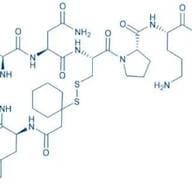
CAS:Potent oxytocin antagonist with a pA₂ value of 7.35 ± 0.08. (d(CH₂)₅¹,Tyr(Me)²,Orn⁸)-Vasotocin has been used to support the hypothesis that pituitary secretion of oxytocin is associated with coactivation of centrally projecting brain oxytocin pathways, some of which are causally related to the induced inhibition of food intake. Furthermore, this compound competitively inhibited arginine vasotocin (AVT) contractions without affecting AVT efficacy.Formula:C48H74N12O12S2Purity:99.2%Color and Shape:White PowderMolecular weight:1075.32[β-Mercapto-β,β-cyclopentamethylenepropionyl1, O-Me-Tyr2, Orn8]-Oxytocin
CAS:Formula:C48H74N12O12S2Molecular weight:1075.30(d(CH2)51,Tyr(Me)2,Orn8)-Oxytocin
CAS:(d(CH2)51,Tyr(Me)2, Orn8)-Oxytocin (OVT) is an antagonist of the oxytocin receptor that finds application in the study of neurological diseases [1].Formula:C48H74N12O12S2Purity:98%Color and Shape:SolidMolecular weight:1075.3(d(CH2)51,Tyr(Me)2, Orn 8)-Oxytocin trifluoroacetate salt
CAS:Oxytocin is a hormone that is produced in the hypothalamus and released by the posterior pituitary gland. It is used to facilitate childbirth and breastfeeding, as well as for postpartum hemorrhage. Oxytocin has been shown to have dose-dependent effects on various tissues such as the kidney, heart, uterus, and brain. Oxytocin also has an effect on cellular functions such as cell growth and proliferation. This drug has been shown to increase blood pressure in rats and may also have some effect on sexual behavior by acting on response element-binding protein in tissues of the brain.Formula:C48H74N12O12S2Purity:Min. 95%Molecular weight:1,075.31 g/mol

![[β-Mercapto-β,β-cyclopentamethylenepropionyl1, O-Me-Tyr2, Orn8]-Oxytocin](/_next/image/?url=https%3A%2Fstatic.cymitquimica.com%2Fproducts%2F7W%2Fthumb%2FGL3626.jpg&w=3840&q=75)