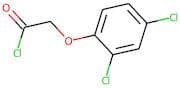
CAS 774-74-3
:2-(2,4-Dichlorophenoxy)acetyl chloride
Description:
2-(2,4-Dichlorophenoxy)acetyl chloride, with the CAS number 774-74-3, is an organic compound characterized by its acetyl chloride functional group attached to a 2,4-dichlorophenoxy moiety. This compound typically appears as a colorless to pale yellow liquid and is known for its reactivity, particularly as an acylating agent in organic synthesis. It is soluble in organic solvents such as dichloromethane and ether but is generally insoluble in water due to its hydrophobic nature. The presence of chlorine atoms in its structure contributes to its biological activity and potential applications in agrochemicals, particularly as a herbicide. However, it is important to handle this compound with care, as it can be corrosive and may cause irritation to the skin, eyes, and respiratory system. Proper safety precautions, including the use of personal protective equipment, are essential when working with this chemical. Additionally, it should be stored in a cool, dry place away from incompatible substances to prevent hazardous reactions.
Formula:C8H5Cl3O2
InChI:InChI=1S/C8H5Cl3O2/c9-5-1-2-7(6(10)3-5)13-4-8(11)12/h1-3H,4H2
InChI key:InChIKey=FUJSJWRORKKPAI-UHFFFAOYSA-N
SMILES:O(CC(Cl)=O)C1=C(Cl)C=C(Cl)C=C1
Synonyms:- (2,4-Dichlorophenoxy)acetyl chloride
- (2,6-Dichlorophenoxy)Acetyl Chloride
- 2-(2,4-Dichlorophenyloxy)acetyl chloride
- Acetyl chloride, (2,4-dichlorophenoxy)-
- Acetyl chloride, 2-(2,4-dichlorophenoxy)-
- 2-(2,4-Dichlorophenoxy)acetyl chloride
Sort by
Purity (%)
0
100
|
0
|
50
|
90
|
95
|
100
Found 3 products.
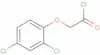
(2,4-Dichlorophenoxy)acetyl chloride
CAS:(2,4-Dichlorophenoxy)acetyl chloridePurity:≥95%Color and Shape:SolidMolecular weight:239.48g/mol(2,4-Dichlorophenoxy)acetyl chloride
CAS:2,4-Dichlorophenoxy)acetyl chloride is a chloroacetyl chloride that can be used as an herbicide. It is soluble in organic solvents and has been reported to inhibit the growth of weeds in agricultural fields. 2,4-Dichlorophenoxy)acetyl chloride inhibits weed growth by inhibiting the synthesis of enzymes needed for photosynthesis, which results in the death of plants. The herbicide is also insoluble in water, meaning it does not leach into the soil and contaminate groundwater. 2,4-Dichlorophenoxy)acetyl chloride has been shown to be toxic to fish at high concentrations. 2,4-Dichlorophenoxy)acetyl chloride reacts with phosphorus pentoxide to form a dichlorophenyldiphenylmethane (DDPM). DDPM is an acceptor molecule that can be used as a starting point for synthesizing other molecules.Formula:C8H5Cl3O2Purity:Min. 95%Molecular weight:239.49 g/mol