CAS 7766-38-3
:N-(4-Nitrophenyl)acrylamide
Description:
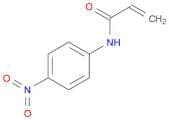
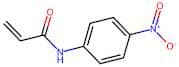
N-(4-Nitrophenyl)acrylamide, with the CAS number 7766-38-3, is an organic compound characterized by its acrylamide backbone substituted with a 4-nitrophenyl group. This compound typically appears as a yellow crystalline solid and is known for its role in various chemical reactions, particularly in polymer chemistry and as a building block in the synthesis of functional materials. It possesses a reactive double bond characteristic of acrylamides, making it suitable for polymerization processes. The presence of the nitrophenyl group imparts unique electronic properties, enhancing its utility in applications such as dye synthesis and as a potential intermediate in pharmaceuticals. N-(4-Nitrophenyl)acrylamide is also noted for its potential biological activity, which may include antimicrobial properties. However, handling this compound requires caution due to its potential toxicity and the need for appropriate safety measures in laboratory settings. Overall, its distinctive chemical structure and properties make it a valuable compound in both research and industrial applications.
Formula:C9H8N2O3
InChI:InChI=1S/C9H8N2O3/c1-2-9(12)10-7-3-5-8(6-4-7)11(13)14/h2-6H,1H2,(H,10,12)
InChI key:InChIKey=DFKKBOJXPCXEGX-UHFFFAOYSA-N
SMILES:N(C(C=C)=O)C1=CC=C(N(=O)=O)C=C1
Synonyms:- 2-Propenamide, N-(4-nitrophenyl)-
- 4′-Nitroacrylanilide
- Acrylanilide, 4′-nitro-
- Ai3-61974
- N-(4-Nitrophenyl)-2-propenamide
- N-(4-nitrophenyl)prop-2-enamide
- N-Acryloyl-p-nitroaniline
- p-Nitroacryloylanilide
- N-(4-Nitrophenyl)acrylamide
Sort by
Purity (%)
0
100
|
0
|
50
|
90
|
95
|
100
Found 4 products.
N-(4-Nitrophenyl)acrylamide
CAS:Formula:C9H8N2O3Purity:97%Color and Shape:SolidMolecular weight:192.1714N-(4-NITROPHENYL)ACRYLAMIDE
CAS:Formula:C9H8N2O3Purity:95.0%Color and Shape:Liquid, No data available.Molecular weight:192.174N-(4-Nitrophenyl)prop-2-enamide
CAS:4-Nitrophenylprop-2-enamide (NPPEA) is a chloride ionophore that can be used to measure the uptake of chloride ions. By adding NPPEA to a solution containing an organic solvent, such as acetonitrile, and metal ions, such as copper or zinc, it is possible to form a complex with the metal ions and measure its uptake by measuring the change in absorbance at 550 nm. This technique is used to measure the uptake of chloride ion by cells in culture. NPPEA has been shown to have anticancer activity in vitro and in vivo. It inhibits DNA synthesis by inhibiting hydroxylase activity and methylation reactions. The functional theory suggests that this inhibition may be due to binding of NPPEA to guanine molecules at sites on the DNA where they are susceptible to attack by reactive oxygen species generated during metabolism.Formula:C9H8N2O3Purity:Min. 95%Molecular weight:192.17 g/mol