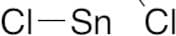
CAS 7772-99-8
:Stannous chloride
- Dichlorotin
- Dichlorure d'etain
- Dicloruro De Estano
- Niklad 261
- Stannous Chloride
- Stannous Chloride AR (5LB/BT)
- Stannous chloride (anhydrous)
- Stannous dichloride
- Stannum dichloride
- Tin (Ii) Chloride
- Tin Dichloride
- Tin chloride
- Tin chloride (SnCl<sub>2</sub>)
- Tin dichloride (SnCl2)
- Tin dichloride (SnCl<sub>2</sub>)
- Tin protochloride
- Uniston CR-HT 200
- Zinn(Ii)-Chlorid
- Zinndichlorid
- C.I. 77864
- Tin ii chloride anhydrous
- Tin chloride anhydrous
- dichlorostannane
- Tin chloride (SnCl2)
- See more synonyms
Tin(II) chloride, anhydrous, 98%
CAS:Tin(II) chloride is widely used as a reducing agent in organic synthesis, for example conversion of quinones into hydroquinones, nitroaromatics into aromatic amines, and in Stephen reduction. It can be used to reduce certain metal salts into metals, tin plating, analytical testing of mercury ions,Formula:Cl2SnPurity:98%Color and Shape:Crystals or powder or crystalline powder, WhiteMolecular weight:189.61Tin(II) chloride, anhydrous, 99% min
CAS:Tin(II) chloride is widely used as a reducing agent in organic synthesis, for example conversion of quinones into hydroquinones, nitroaromatics into aromatic amines, and in Stephen reduction. It acts as an antisludging agent and a stabilizer. It can be used to reduce certain metal salts into metalFormula:Cl2SnPurity:99%Color and Shape:White to pale grey, SolidMolecular weight:189.61Tin(II) chloride, ultra dry, 99.9985% (metals basis)
CAS:Tin(II) chloride is widely used as a reducing agent in organic synthesis, for example conversion of quinones into hydroquinones, nitroaromatics into aromatic amines, and in Stephen reduction. It acts as an antisludging agent and a stabilizer. It can be used to reduce certain metal salts into metalFormula:Cl2SnPurity:99.9985%Color and Shape:Powder, WhiteMolecular weight:189.61Tin(II) chloride, anhydrous, 98%
CAS:Tin(II) chloride, anhydrous, 98%
Formula:SnCl2Purity:98%Color and Shape:white xtl.Molecular weight:189.60Tin(II) chloride
CAS:Formula:SnCl2Purity:(Titration) 99.0 - 101.0 %Color and Shape:White to off-white or faint beige powder, crystals or flakesMolecular weight:189.62Tin(II) chloride, anhydrous
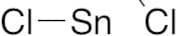
CAS:Tin(II) chloride, anhydrousFormula:·Sn·2ClPurity:98%Color and Shape: white crystalline flakes to crytalline flakes to crystalline powderMolecular weight:189.62g/molTin(II) Chloride [for Perovskite precursor]
CAS:Formula:SnCl2Purity:>97.0%(T)Color and Shape:White to Almost white powder to crystalMolecular weight:189.61Tin(II) chloride, anhydrous, 97.0%
CAS:Formula:SnCl2Purity:≥ 97.0%Color and Shape:White to tan or purple crystalline solidMolecular weight:189.60Tin (II) Chloride
CAS:Controlled ProductStability Moisture Sensitive
Applications Tin (II) Chloride (in dilute solutions of HCl) is used as a reductant, and is utilized to prepare surfaces for electroless plating. Tin (II) Chloride is also used as a mordant in the textile industry because of its ability to form an insoluble precipitate with the dye, ultimately fixing it into the fiber. Tin (II) Chloride is also a reagent that is known to produce DNA damage in Chinese hamster ovary cells.
Not a dangerous good if item is equal to or less than 1g/ml and there is less than 100g/ml in the package
References Cohen, R., et al.: J. Electrochem. Soc., 119, 433 (1972); Jothi, D.: Autex. Res. J., 8, 49 (2008); McLean, J., et al.: Mutat. Res. Lett., 119, 195 (1983);Formula:SnCl2Color and Shape:NeatMolecular weight:189.6Stannous chloride anhydrous
CAS:Stannous chloride anhydrous is a particle with a particle size of 3-6 microns and a melting point of 8°C. It has been shown in toxicity studies to be non-toxic to rats and rabbits when administered orally. Stannous chloride anhydrous is a coordination compound that contains stannous ion, which is coordinated by four sulfur atoms and two nitrogen atoms. The molecule can also have different geometries depending on the solvent used; for example, in trifluoroacetic acid, it adopts a trigonal bipyramidal geometry. Stannous chloride anhydrous has been shown to inhibit enzymes such as pepsin, chymotrypsin, and trypsin. This inhibition may be due to its ability to bind covalently with these enzymes.Formula:Cl2SnPurity:Min. 95%Color and Shape:PowderMolecular weight:189.62 g/mol
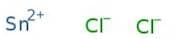

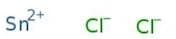







![Tin(II) Chloride [for Perovskite precursor]](/_next/image/?url=https%3A%2Fstatic.cymitquimica.com%2Fproducts%2F3B%2Fthumb%2FT3570.jpg&w=3840&q=75)