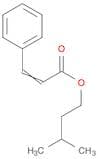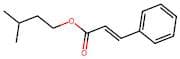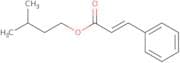
CAS 7779-65-9
:Isoamyl cinnamate
Description:
Isoamyl cinnamate, with the CAS number 7779-65-9, is an organic compound that belongs to the class of esters. It is formed from the reaction of isoamyl alcohol and cinnamic acid. This substance is characterized by its pleasant, fruity aroma, often described as reminiscent of bananas or pears, making it a popular choice in the fragrance and flavoring industries. Isoamyl cinnamate is typically a colorless to pale yellow liquid with a relatively low boiling point. It is soluble in organic solvents but has limited solubility in water. The compound is known for its stability under normal conditions, although it may undergo hydrolysis in the presence of strong acids or bases. Isoamyl cinnamate is used in various applications, including perfumes, cosmetics, and food flavorings, due to its appealing scent profile. Additionally, it may have potential applications in the field of natural product synthesis and as a flavoring agent in the food industry. Safety data should be consulted for handling and exposure guidelines.
Formula:C14H18O2
InChI:InChI=1S/C14H18O2/c1-12(2)10-11-16-14(15)9-8-13-6-4-3-5-7-13/h3-9,12H,10-11H2,1-2H3
InChI key:InChIKey=JFHCDEYLWGVZMX-UHFFFAOYSA-N
SMILES:C(=CC(OCCC(C)C)=O)C1=CC=CC=C1
Synonyms:- 2-Propenoic acid, 3-phenyl-, 3-methylbutyl ester
- 3-methylbutyl (2E)-3-phenylprop-2-enoate
- Cinnamic acid, isopentyl ester
- Iso-Amyl Cinnamate
- Isopentyl alcohol, cinnamate
- isopentyl (Z)-3-phenylprop-2-enoate
- Isoamyl cinnamate
Sort by
Purity (%)
0
100
|
0
|
50
|
90
|
95
|
100
Found 3 products.
3-methylbutyl (2E)-3-phenylprop-2-enoate
CAS:Formula:C14H18O2Purity:98%Color and Shape:LiquidMolecular weight:218.2915Isoamyl cinnamate
CAS:Isoamyl cinnamate is a synthetic compound that is used as an intermediate for the production of detergents. It has been shown to inhibit the growth of yeast and fungi, such as Cryptococcus neoformans and Candida glabrata. Isoamyl cinnamate also has anti-microbial properties that may be related to its ability to produce propionate, which can kill bacteria in urine samples. This compound is not known to bioaccumulate or cause toxicity in humans at normal doses.Formula:C14H18O2Purity:Min. 95%Color and Shape:Clear LiquidMolecular weight:218.29 g/mol