CAS 778-82-5
:Ethyl 1H-indole-3-acetate
Description:
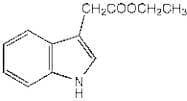
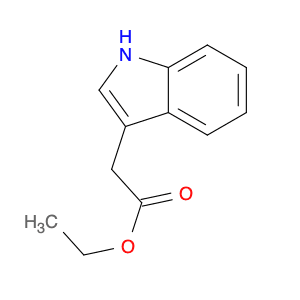
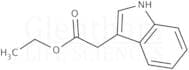
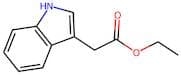
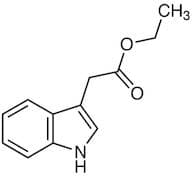
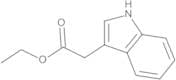
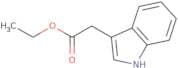
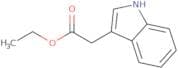
Ethyl 1H-indole-3-acetate, with the CAS number 778-82-5, is an organic compound that belongs to the class of indole derivatives. It features an indole ring, which is a bicyclic structure composed of a benzene ring fused to a pyrrole ring, and an acetate functional group attached to the nitrogen atom of the indole. This compound is typically a colorless to pale yellow liquid with a characteristic odor. Ethyl 1H-indole-3-acetate is known for its applications in the synthesis of various pharmaceuticals and agrochemicals, as well as its potential use in perfumery due to its pleasant fragrance. It is moderately soluble in organic solvents and exhibits low solubility in water. The compound is stable under normal conditions but should be handled with care, as it may pose health risks if ingested or inhaled. Its reactivity can be influenced by the presence of other functional groups and environmental conditions, making it a subject of interest in organic synthesis and medicinal chemistry.
Formula:C12H13NO2
InChI:InChI=1S/C12H13NO2/c1-2-15-12(14)7-9-8-13-11-6-4-3-5-10(9)11/h3-6,8,13H,2,7H2,1H3
InChI key:InChIKey=HUDBDWIQSIGUDI-UHFFFAOYSA-N
SMILES:C(C(OCC)=O)C=1C=2C(NC1)=CC=CC2
Synonyms:- (1H-Indol-3-yl)acetic acid ethyl ester
- 1H-indole-3-acetic acid, ethyl ester
- 3-[(Ethoxycarbonyl)methyl]indole
- Ethyl (1H-indol-3-yl)acetate
- Ethyl 1H-indol-3-ylacetate
- Ethyl 1H-indole-3-acetate
- Ethyl 2-(1H-indol-3-yl)acetate
- Ethyl 2-(indol-3-yl)acetate
- Ethyl indole-3-acetate
- Ethyl β-indolylacetate
- IAA ethyl ester
- Indole-3-acetic acid, ethyl ester
- See more synonyms
Sort by
Purity (%)
0
100
|
0
|
50
|
90
|
95
|
100
Found 9 products.
Ethyl indole-3-acetate, 98+%
CAS:This Thermo Scientific Chemicals brand product was originally part of the Alfa Aesar product portfolio. Some documentation and label information may refer to the legacy brand. The original Alfa Aesar product / item code or SKU reference has not changed as a part of the brand transition to Thermo SciFormula:C12H13NO2Purity:98+%Color and Shape:White to cream to pale brown or pale yellow, PowderMolecular weight:203.24Ethyl 2-(1H-indol-3-yl)acetate
CAS:Formula:C12H13NO2Purity:98%Color and Shape:SolidMolecular weight:203.2371Indole-3-acetic acid ethyl ester
CAS:Formula:C12H13NO2Purity:≥ 98.0%Color and Shape:White to light yellow or pale-brown powder to crystalsMolecular weight:203.24Ethyl 2-(1H-indol-3-yl)acetate
CAS:Ethyl 2-(1H-indol-3-yl)acetatePurity:98%Molecular weight:203.24g/molEthyl 3-Indoleacetate
CAS:Formula:C12H13NO2Purity:>98.0%(GC)Color and Shape:White to Light yellow to Light orange powder to crystalMolecular weight:203.24Ethyl Indole-3-acetate
CAS:Controlled ProductApplications Ethyl Indole-3-acetate is a compound used in the synthesis of 9H-Pyrrolo[1,2-α]Indoles via Michael Addition-Condensation with α,β-Unsaturated Ketimines.
References Zhang, M., et al.: J. Heterocyclic Chem. (2016)Formula:C12H13NO2Color and Shape:NeatMolecular weight:203.24Indole-3-acetic acid ethyl ester
CAS:Indole-3-acetic acid ethyl ester is a fine chemical that is used as a building block for synthesis of more complex compounds. It is a versatile building block that can be used in reactions to produce useful intermediates and scaffolds. Indole-3-acetic acid ethyl ester has been used to synthesize indole derivatives, which are useful in the research of cancer and Alzheimer's disease. Indole-3-acetic acid ethyl ester can also be used to produce indoles as well as other heterocyclic compounds, such as benzoxazines. The compound has CAS number 778-82-5.Formula:C12H13NO2Purity:Min. 99.0 Area-%Molecular weight:203.24 g/molEthyl indole-3-acetate
CAS:Ethyl indole-3-acetate (EIA) is a compound that inhibits the growth of certain cancer cells. It belongs to the group of acyl halides. EIA inhibits the synthesis of nucleic acids, proteins and other macromolecules by the cancer cells. It has been shown to be effective in reducing the size of tumors in mice with prostate and breast cancer. This compound also inhibits enzymes such as abscisic acid oxidase, which is responsible for converting abscisic acid into reactive oxygen species. EIA has been shown to have hemolytic activity in human lung tissue, but not ovules or human erythrocytes. This may be due to its ability to inhibit hormone production and cause an increase in progesterone levels.Formula:C12H13NO2Purity:Min. 95%Color and Shape:PowderMolecular weight:203.24 g/molEthyl 3-indoleacetate
CAS:Formula:C12H13NO2Purity:98%Color and Shape:Solid, CrystallineMolecular weight:203.241