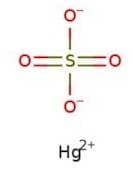
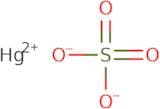
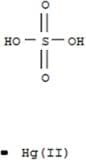
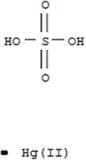
CAS 7783-35-9
:Mercuric sulfate
- Mercuric sulfate
- Mercury Sulphate
- Mercury bisulfate
- Mercury sulfate (HgSO<sub>4</sub>)
- Mercury(II) sulphate
- Mercurysulfate
- Sulfuric acid, mercury(2+) salt (1:1)
- Mercury sulfate (HgSO4)
- Mercury(II) sulfate
- Mercury (II) sulfate
Mercury(II) sulfate, 98+%
CAS:It is used in medicine as a catalyst and in extracting gold and silver. This Thermo Scientific Chemicals brand product was originally part of the Alfa Aesar product portfolio. Some documentation and label information may refer to the legacy brand. The original Alfa Aesar product / item code or SKU rFormula:HgO4SPurity:98+%Color and Shape:Crystals or Crystalline powder, WhiteMolecular weight:296.65Reagecon Potassium Dichromate 0.04M (0.24N) Analytical Volumetric Solution (AVL)
CAS:Reagecon's Potassium Dichromate 0.04M (0.24N) Analytical Volumetric Solution (AVL) is a fully factorised, high purity, stable product, developed and tested for oxidation/reduction titrations. This Analytical Volumetric Solution, also called titrant, standard titrant or standard solution, is tested to a specification of ± 0.1%. It is a reagent of known concentration, that is dispensed from a burette or other dispensing apparatus to a sample (analyte), until a reaction between the two liquids is judged to be complete. The product may be used for manual titrations, or more commonly automatic titrations, to determine the end points by detection of any of several properties. Oxidation/reduction titrations depend on changes in the electropotential of the oxidation reduction system and always involves a reaction between an oxidising and reducing pair. - Titration is a rapid, economical and versatile analytical tool. This Reagecon titrant is accurate, stable, reproducible and fully factorised. Titrations performed with this product, exhibit defined stoichiometry, are quantitative, establish an equilibrium that is definitive and fast and provide unambiguous results. Stability is proven (either opened or unopened) for the shelf life of this product.Color and Shape:LiquidReagecon 20% w/v Mercury (II) Sulphate in 10% w/v Sulphuric Acid Chemical Oxygen Demand (COD) Reagent
CAS:Color and Shape:LiquidMercury(II) sulfate, min. 98%
CAS:Mercury(II) sulfate, min. 98%
Formula:HgSO4Purity:min. 98%Color and Shape:white pwdr.Molecular weight:296.67Mercury(II) sulfate
CAS:Controlled ProductMercury(II) sulfate is a chemical compound with the molecular formula HgSO4. It is a salt of mercury and sulfuric acid that is used in analytical chemistry as a reagent to detect fatty acids. Mercury(II) sulfate forms an acidic solution when mixed with water, so it can be used to precipitate metals such as potassium dichromate or sodium carbonate. This compound also has been used in the treatment of autoimmune diseases and cervical cancer. Mercury(II) sulfate reacts with phosphotungstic acid to form mercuric phosphotungstate, which can be detected by x-ray crystallography if it is present in the crystal lattice. Mercury(II) sulfate also reacts with hydroxyl groups to form mercuric oxychloride, which can be detected by hydrochloric acid.
Formula:HgSO4Purity:Min. 95%Color and Shape:White/Off-White SolidMolecular weight:297.92237Mercuric Sulphate ACS, 99%
CAS:Formula:HgSO4Purity:min. 99%Color and Shape:White, Crystalline powder, Clear, ColourlessMolecular weight:296.65Mercuric Sulphate pure, 99%
CAS:Formula:HgSO4Purity:min. 99%Color and Shape:White, Crystalline powder, Clear, ColourlessMolecular weight:296.65Mercuric Sulphate ACS, ExiPlus, Multi-Compendial, 99%
CAS:Formula:HgSO4Purity:min. 99%Color and Shape:White, Crystalline powder, Clear, ColourlessMolecular weight:296.65