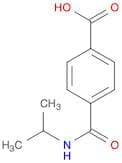
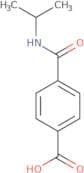
CAS 779-47-5
:4-(propan-2-ylcarbamoyl)benzoic acid
Description:
4-(Propan-2-ylcarbamoyl)benzoic acid, also known by its CAS number 779-47-5, is an organic compound characterized by its aromatic structure and functional groups. It features a benzoic acid moiety with a propan-2-ylcarbamoyl substituent at the para position. This compound is typically a white to off-white solid, exhibiting moderate solubility in polar solvents such as water and alcohols, while being less soluble in non-polar solvents. The presence of both the carboxylic acid and amide functional groups contributes to its potential as a weak acid and influences its reactivity and interaction with other molecules. It may participate in hydrogen bonding due to the amide and carboxylic acid functionalities, which can affect its physical properties and biological activity. This compound is of interest in various fields, including pharmaceuticals and materials science, due to its potential applications in drug formulation and as a building block in organic synthesis. Safety data should be consulted for handling and usage, as with all chemical substances.
Formula:C11H13NO3
InChI:InChI=1/C11H13NO3/c1-7(2)12-10(13)8-3-5-9(6-4-8)11(14)15/h3-7H,1-2H3,(H,12,13)(H,14,15)
SMILES:CC(C)NC(=O)c1ccc(cc1)C(=O)O
Synonyms:- Terephthalic Acid Isopropylamide
Sort by
Purity (%)
0
100
|
0
|
50
|
90
|
95
|
100
Found 2 products.
N-Isopropylterephthalamic acid
CAS:N-Isopropylterephthalamic acid is a metabolite of terephthalic acid and is formed by the oxidation of isopropyl alcohol. The metabolism of N-isopropylterephthalamic acid in humans has been shown to be catalyzed by cytochrome P450 enzymes, which are expressed in the liver. This reaction occurs through a series of oxidation steps that convert the alcohol group to an aldehyde group and then to an acid group. The final product, N-isopropylterephthalamic acid, can be quantified using gas chromatography with electron capture detection or high performance liquid chromatography with fluorescence detection. These techniques can be used for monitoring human exposure to this metabolite.Formula:C11H13NO3Purity:Min. 95%Molecular weight:207.23 g/mol