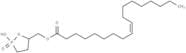
CAS 779333-58-3
:Sort by
Purity (%)
0
100
|
0
|
50
|
90
|
95
|
100
Found 2 products.
Oleoyl 3-carbacyclic phosphatidic acid
CAS:Oleoyl 3-carbacyclic phosphatidic acid is a medicinal compound with potential anticancer properties. It has been shown to induce apoptosis, or programmed cell death, in Chinese hamster ovary cells and human cancer cells. This compound also inhibits kinases, which are enzymes that play a crucial role in regulating cellular processes such as cell division and growth. Oleoyl 3-carbacyclic phosphatidic acid is an analog of lysophosphatidic acid, which is a signaling molecule involved in various physiological processes. This compound may have therapeutic potential as an inhibitor of cancer cell growth and proliferation. Further research is needed to explore its potential use as an anticancer agent.
Formula:C22H41O5PPurity:Min. 95%Molecular weight:416.5 g/molOleoyl 3-carbacyclic Phosphatidic Acid
CAS:Cyclic Phosphatidic Acids (cPAs) are naturally occurring lysophosphatidic acid (LPA) analogs, characterized by a 5-membered ring formed between the sn-2 hydroxy group and the sn-3 phosphate. Carba-derivatives of cPA (ccPA) modify the sn-2 (2-ccPA) or sn-3 (3-ccPA) linkage, hindering the conversion of cPA into LPA. Oleoyl 3-Carbacyclic Phosphatidic Acid (3-ccPA 18:1) incorporates the 18:1 fatty acid oleate at the sn-1 position on the glycerol backbone, acting as a cyclic LPA analog. This compound, at a concentration of 25 μM, blocks MM1 cells' transcellular migration through mesothelial cell monolayers induced by fetal bovine serum (by 90.1%) or LPA (by 99.9%), without impeding cell proliferation. Additionally, 3-ccPA 18:1, in the 0.1-1.0 μM range, notably suppresses autotaxin, which plays a vital role in various cancer cell behaviors including survival, growth, migration, invasion, and metastasis.Formula:C22H41O5PColor and Shape:SolidMolecular weight:416.5