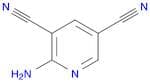
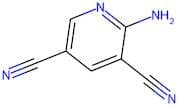
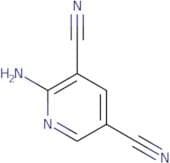
CAS 78473-10-6
:2-amino-3,5-dicyanopyridinium
2-Aminopyridine-3,5-dicarbonitrile
CAS:Formula:C7H4N4Purity:97%Color and Shape:SolidMolecular weight:144.13352-Aminopyridine-3,5-dicarbonitrile
CAS:2-Aminopyridine-3,5-dicarbonitrilePurity:97%Molecular weight:144.14g/mol2-aminopyridine-3,5-dicarbonitrile
CAS:Formula:C7H4N4Purity:≥97%Color and Shape:SolidMolecular weight:144.1372-Amino-3,5-pyridinedicarbonitrile
CAS:Controlled ProductFormula:C7H4N4Color and Shape:NeatMolecular weight:144.1332-Amino-3,5-pyridinedicarbonitrile
CAS:2-Amino-3,5-pyridinedicarbonitrile (APDC) is a small molecule that has been shown to bind to the adenosine A1 receptor with high affinity and selectivity. It has a molecular weight of 167.2 g/mol, a pK of 7.4 and a logP value of 2.8. APDC was first synthesized in 1963 by scientists at the National Institute for Medical Research in London. The chlorine atom is influential in the pharmacokinetics of this compound. The pharmacokinetic profile shows that APDC is poorly absorbed and eliminated quickly from the body, with an elimination half-life of 0.6 hours and an oral bioavailability of less than 1%. This drug also has multipotent effects on Alzheimer's disease, showing significant efficacy against both plaques and tangles in animal models of Alzheimer's disease.
Formula:C7H4N4Purity:Min. 95%Molecular weight:144.13 g/mol