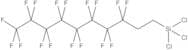
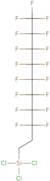
CAS 78560-44-8
:1H,1H,2H,2H-Perfluorodecyltrichlorosilane
- (1,1,2,2-Tetrahydroperfluorodecyl)trichlorosilane
- (1H,1H,2H,2H-Heptadecafluorodecyl)trichlorosilane
- (Heptadecafluoro-1,1,2,2-tetrahydradecyl)trichlorosilane
- (Heptadecafluoro-1,1,2,2-tetrahydrodecyl)trichlorosilane
- (Perfluorooctylethyl)trichlorosilane
- 3,3,4,4,5,5,6,6,7,7,8,8,9,9,10,10,10-Heptadecafluorodecyltrichlorosilane
- FDTS~Trichloro-1H,1H,2H,2H-perfluorodecylsilane
- Fc 10
- Gelest SIH 5841.0
- Heptadecafluoro-1,1,2,2-tetrahydrooctyltrichlorosilane
- Hftcs
- Ks 3175
- Perfluorodecyltrichlorosilane
- SG-Si 191
- Sih 5841.0
- Silane, trichloro(3,3,4,4,5,5,6,6,7,7,8,8,9,9,10,10,10-heptadecafluorodecyl)-
- Trichloro(1H,1H,2H,2H-perfluorodecyl)silane
- Trichloro(3,3,4,4,5,5,6,6,7,7,8,8,9,9,10,10,10-heptadecafluorodecyl)silane
- Tsl 8232
- [2-(Perfluorooctyl)ethyl]trichlorosilane
- TRICHLORO-1H,1H,2H,2H-PERFLUORODECYLSILANE
- 1H,1H,2H,2H-PERFLUORODECYLTRICHLOROSILANE
- FDTS
- PERFLUORODECYL-1H,1H,2H,2H-TRICHLOROSILANE
- 1H,1H,2H,2H-Perfluorodecyltrichlorosilane(Trichloro-1H,1H,2H,2H-perfluorodecylsilane)
- 1H,1H,2H,2H-Perfluorodecyltrichlorosilane97%
- (HEPTADECAFLUORO-1,1,2,2-TETRAHYDRODECYL)-1-TRICHLOROSILANE
- See more synonyms
(HEPTADECAFLUORO-1,1,2,2-TETRAHYDRODECYL)TRICHLOROSILANE
CAS:ALD Material
Atomic layer deposition (ALD) is a chemically self-limiting deposition technique that is based on the sequential use of a gaseous chemical process. A thin film (as fine as -0.1 Å per cycle) results from repeating the deposition sequence as many times as needed to reach a certain thickness. The major characteristic of the films is the resulting conformality and the controlled deposition manner. Precursor selection is key in ALD processes, namely finding molecules which will have enough reactivity to produce the desired films yet are stable enough to be handled and safely delivered to the reaction chamber.
Fluorinated Alkyl Silane - Conventional Surface Bonding
Aliphatic, fluorinated aliphatic or substituted aromatic hydrocarbon substituents are the hydrophobic entities which enable silanes to induce surface hydrophobicity. The organic substitution of the silane must be non-polar. The hydrophobic effect of the organic substitution can be related to the free energy of transfer of hydrocarbon molecules from an aqueous phase to a homogeneous hydrocarbon phase. A successful hydrophobic coating must eliminate or mitigate hydrogen bonding and shield polar surfaces from interaction with water by creating a non-polar interphase. Although silane and silicone derived coatings are in general the most hydrophobic, they maintain a high degree of permeability to water vapor. This allows coatings to breathe and reduce deterioration at the coating interface associated with entrapped water. Since ions are not transported through non-polar silane and silicone coatings, they offer protection to composite structures ranging from pigmented coatings to rebar reinforced concrete. A selection guide for hydrophobic silanes can be found on pages 22-31 of the Hydrophobicity, Hydrophilicity and Silane Surface Modification brochure. A selection guide for hydrophobic silanes can be found on pages 22-31 of the Hydrophobicity, Hydrophilicity and Silane Surface Modification brochure.
Heptadecafluoro-1,1,2,2-tetrahydrodecyltrichlorosilane; Perfluorodecyl-1H,1H,2H,2H-trichlorosilane; (1H,1H,2H,2H-perfluorodecyl)trichlorosilane; FDTS
Packaged over copper powderγc of treated surfaces: 12 mN/mFormula:C10H4Cl3F17SiPurity:97%Color and Shape:Clear Or Colored (Green Pink Or Yellow) LiquidMolecular weight:581.56Perfluorodecyl-1H,1H,2H,2H-trichlorosilane, 97% FTDS
CAS:Formula:C10H4Cl3F17SiPurity:97%Color and Shape:colorless liq.Molecular weight:581.56Trichloro(1H,1H,2H,2H-heptadecafluorodecyl)silane
CAS:Controlled ProductTrichloro(1H,1H,2H,2H-heptadecafluorodecyl)silane is a chemical substance that belongs to the group of synthetic substances. It has been shown to have antiviral properties in clinical studies. Trichloro(1H,1H,2H,2H-heptadecafluorodecyl)silane is used to synthesize thymidylate by a two-step process. The first step involves the hydrolysis of sodium hydroxide solution in the presence of hydroxide solution and chemical substances. The second step involves the reaction of synthase enzyme with waveform and water vapor to produce monolayer. This product also has antiviral activity against human pathogens such as HIV and herpes simplex virus type 1 (HSV-1).Formula:C10H4Cl3F17SiPurity:Min. 95%Color and Shape:Clear LiquidMolecular weight:581.56 g/mol