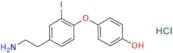
![Phenol,4-[4-(2-aminoethyl)-2-iodophenoxy]-, hydrochloride (1:1)](/_next/image/?url=https%3A%2Fstatic.cymitquimica.com%2Fcas-image%2Fthumb-webp%2F201399-phenol-4-4-2-aminoethyl-2-iodophenoxy-hydrochloride-1-1.webp&w=3840&q=75)
CAS 788824-64-6
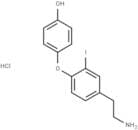
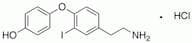
:Phenol,4-[4-(2-aminoethyl)-2-iodophenoxy]-, hydrochloride (1:1)
- Phenol,4-[4-(2-aminoethyl)-2-iodophenoxy]-, hydrochloride (9CI)
- 3-Iodothyronamine hydrochloride
3-Iodothyronamine hydrochloride
CAS:3-Iodothyronamine hydrochloride, Thyroid hormone derivative, activates TAAR1, induces hypothermia, for endocrine/metabolic research.Formula:C14H15ClINO2Color and Shape:SolidMolecular weight:391.633-Iodothyronamine Hydrochloride
CAS:Controlled ProductApplications 3-Iodothyronamine is a novel metabolite of thyroid hormone (TH). 3-Iodothyronamine (T1AM) is an endogenous and rapid-acting derivative of thyroid hormone. It has alos been found to increase food intake in rodents.
Not a dangerous good if item is equal to or less than 1g/ml and there is less than 100g/ml in the package
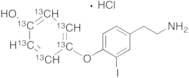
References Davis, P., et al.: Thyroid, 6, 497 (1996), Falkenstein, E., et al.: Pharmacol. Rev., 52, 513 (2000), Yen, P., et al.: Physiol. Rev., 81, 1097 (2001), Pinna, G., et al.: Endocrinology, 143, 1789 (2002), Dhillo et al.; Diabetes, Obesity & Metabolism (2008), 10(2), 167-70Formula:C14H14INO2·ClHColor and Shape:NeatMolecular weight:391.633-Iodothyronamine (4-Hydroxyphenyl-13C6) Hydrochloride
CAS:Controlled ProductApplications 3-Iodothyronamine (4-Hydroxyphenyl-13C6) Hydrochloride is an isotopic analog of 3-Iodothyronamine Hydrochloride (I720500), a novel metabolite of thyroid hormone.
Not a dangerous good if item is equal to or less than 1g/ml and there is less than 100g/ml in the package
References Davis, P., et al.: Thyroid, 6, 497 (1996); Falkenstein, E., et al.: Pharmacol. Rev., 52, 513 (2000); Yen, P., et al.: Physiol. Rev., 81, 1097 (2001); Pinna, G., et al.: Endocrinology, 143, 1789 (2002); Dhillo et al.; Diabetes, Obesity & Metabolism, 10, 167-70 (2008);Formula:C813C6H14INO2•(HCl)Color and Shape:NeatMolecular weight:361.1336463-Iodothyronamine Hydrochloride
CAS:Controlled Product3-Iodothyronamine Hydrochloride is a thyroid hormone that has been shown to activate the camp-dependent protein kinase pathway in vitro. 3-Iodothyronamine Hydrochloride has also been found to have agonist binding activity at amine receptors, and this may be due to its structural similarity with endogenous amines. In addition, 3-Iodothyronamine Hydrochloride has been shown to bind to the human thyroid hormone receptor and inhibit proopiomelanocortin (POMC) expression. It is believed that 3-iodothyronamine hydrochloride may function as a competitive antagonist of thyroxine or triiodothyronine binding to the nuclear thyroid hormone receptor complex, resulting in decreased levels of these hormones. This drug has also been shown to have physiological relevance by being present in human cerebrospinal fluid (CSF).Formula:C14H15ClINO2Purity:Min. 95%Molecular weight:391.63 g/mol