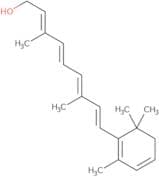
CAS 79-80-1
:3,4-Didehydroretinol
Description:
3,4-Didehydroretinol, also known as 3,4-didehydroretinal, is a derivative of vitamin A and belongs to the class of retinoids. It is characterized by its polyunsaturated structure, which includes a series of conjugated double bonds that contribute to its biological activity and light-absorbing properties. This compound plays a crucial role in the visual cycle, particularly in the formation of visual pigments in the retina. 3,4-Didehydroretinol is typically a yellow to orange solid at room temperature and is soluble in organic solvents such as ethanol and chloroform, but less soluble in water. Its molecular structure allows it to interact with specific proteins, influencing various physiological processes, including vision and cellular differentiation. As a member of the retinoid family, it exhibits potential antioxidant properties and may have implications in skin health and development. However, like other retinoids, it should be handled with care due to its sensitivity to light and heat, which can lead to degradation.
Formula:C20H28O
InChI:InChI=1S/C20H28O/c1-16(8-6-9-17(2)13-15-21)11-12-19-18(3)10-7-14-20(19,4)5/h6-13,21H,14-15H2,1-5H3/b9-6+,12-11+,16-8+,17-13+
InChI key:InChIKey=XWCYDHJOKKGVHC-OVSJKPMPSA-N
SMILES:C(=C/C(=C/C=C/C(=C/CO)/C)/C)\C=1C(C)(C)CC=CC1C
Synonyms:- (all-E)-3,7-Dimethyl-9-(2,6,6-trimethyl-1,3-cyclohexadien-1-yl)-2,4,6,8-nonatetraen-1-ol
- 2,4,6,8-Nonatetraen-1-ol, 3,7-dimethyl-9-(2,6,6-trimethyl-1,3-cyclohexadien-1-yl)-, (all-E)-
- 3,4-Dehydroretinol
- 3,4-Didehydroretinol
- 3-Dehydroretinol
- 3-Dehydroretinol, all-trans-
- Retinol, 3,4-didehydro-
- Vitamin A<sub>2</sub>
- all-trans-3,4-Didehydroretinol
- all-trans-3-Dehydroretinol
- vitamin A2
Sort by
Purity (%)
0
100
|
0
|
50
|
90
|
95
|
100
Found 1 products.
3-Dehydro retinol
CAS:3-Dehydro retinol is a carotenoid that is found in the skin. It is derived from retinol, and has been shown to have antioxidant properties. 3-Dehydro retinol can be isolated from the fungus Monascus purpureus by chromatographic methods. The enzyme activities of 3-dehydroretinol are not well understood, but it has been hypothesized that chronic exposure to this compound may lead to an increase in cell proliferation or an increase in cell differentiation. 3-Dehydro retinol has also been shown to inhibit the oxidation of other molecules such as hydrogen chloride.
Formula:C20H28OPurity:90%MinMolecular weight:284.44 g/mol