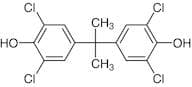
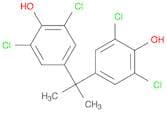
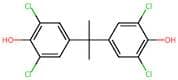
CAS 79-95-8
:Tetrachlorobisphenol A
- 2,2,6,6-Tetrachloro-4,4-Isopropylidenediphenol
- 2,2-Bis(3,5-dichloro-4-hydroxyphenyl)propane
- 2,2-Bis(4-hydroxy-3,5-dichlorophenyl)propane
- 2,2-Bis[3,5-dichloro-4-oxyphenyl]propane
- 2,2′,6,6′-Tetrachlorobisphenol A
- 2,6-Dichloro-4-[2-(3,5-dichloro-4-hydroxyphenyl)propan-2-yl]phenol
- 3,3′,5,5′-Tetrachlorobisphenol A
- 3,5,3′,5′-Tetrachlorobisphenol A
- 4,4'-Propane-2,2-Diylbis(2,6-Dichlorophenol)
- 4,4-Isopropylidenebis(2,6-dichlorophenol)
- 4,4′-(1-Methylethylidene)bis[2,6-dichlorophenol]
- NSC 18248
- NSC 67465
- Phenol, 4,4′-(1-methylethylidene)bis[2,6-dichloro-
- Phenol, 4,4′-isopropylidenebis[2,6-dichloro-
- Tetrachlorobisphenol A
- TetrachlorobisphenolA
- See more synonyms
Tetrachlorobisphenol A
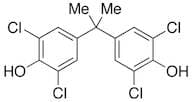
CAS:Formula:C15H12Cl4O2Purity:>98.0%(GC)(T)Color and Shape:White to Almost white powder to crystalMolecular weight:366.063,5,3',5'-Tetrachlorobisphenol A
CAS:Formula:C15H12Cl4O2Purity:98%Color and Shape:SolidMolecular weight:366.06663,5,3',5'-Tetrachlorobisphenol A-d6
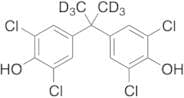
CAS:Controlled ProductApplications 3,5,3',5'-Tetrachlorobisphenol A-d6 is the isotope labelled analog of 3,5,3',5'-Tetrachlorobisphenol A. This compound exhibitis antithyroid hormone activity like Bisphenol A and Tetrabromobisphenol A.
References Freyberger, A., et al.: Toxicol. Lett., 155, 1 (2005), Kitamura, S., et al.: Life Sci., 76, 1589 (2005), Sun, H., et al.: Food Chem. Toxicol., 44, 1916 (2006), Van der Ven, L., et al.: Toxicology, 245, 76 (2008),Formula:C15D6H6Cl4O2Color and Shape:NeatMolecular weight:372.13,5,3',5'-Tetrachlorobisphenol A
CAS:Applications The compound exhibitis antithyroid hormone activity like Bisphenol A and Tetrabromobisphenol A. Flame Retardant
References Freyberger, A., et al.: Toxicol. Lett., 155, 1 (2005), Kitamura, S., et al.: Life Sci., 76, 1589 (2005), Sun, H., et al.: Food Chem. Toxicol., 44, 1916 (2006), Van der Ven, L., et al.: Toxicology, 245, 76 (2008),Formula:C15H12Cl4O2Color and Shape:Off-WhiteMolecular weight:366.074,4′-(Propane-2,2-diyl)bis(2,6-dichlorophenol)
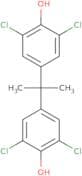
CAS:Purity:98%Color and Shape:SolidMolecular weight:366.0599976Tetrachlorobisphenol A
CAS:Tetrachlorobisphenol A (TCBPA) is a persistent organic pollutant that is used in the manufacturing of polycarbonate plastics and epoxy resins. TCBPA is known to be toxic to humans and has been linked to metabolic disorders, including diabetes mellitus and hepatic steatosis. TCBPA also inhibits mitochondrial membrane potential and gamma-aminobutyric acid release, leading to cytotoxicity in cultured human cells. TCBPA has been found to inhibit cell proliferation and induce apoptosis in MCF-7 breast cancer cells, which may be due to its effects on the mitochondria. TCBPA also binds to DNA, inhibiting the synthesis of proteins necessary for cell division. The matrix effect occurs when an analyte interacts with the solvents used in sample preparation.Formula:C15H12Cl4O2Purity:Min. 95%Molecular weight:366.07 g/mol