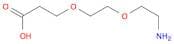
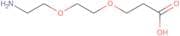
![3-[2-(2-Aminoethoxy)ethoxy]-propanoic acid](/_next/image/?url=https%3A%2Fstatic.cymitquimica.com%2Fcas-image%2Fthumb-webp%2F177081-3-2-2-aminoethoxy-ethoxy-propanoic-acid.webp&w=3840&q=75)
CAS 791028-27-8
:3-[2-(2-Aminoethoxy)ethoxy]-propanoic acid
Description:
3-[2-(2-Aminoethoxy)ethoxy]-propanoic acid, identified by its CAS number 791028-27-8, is a chemical compound characterized by its structure, which includes a propanoic acid moiety linked to a diethanolamine-like side chain. This compound features both amino and ether functional groups, contributing to its potential as a biocompatible molecule. It is likely to exhibit hydrophilic properties due to the presence of the amino and ether groups, which can enhance solubility in aqueous environments. The amino group may also participate in hydrogen bonding, influencing its reactivity and interactions with other molecules. This compound could be of interest in various applications, including pharmaceuticals, where it may serve as a building block for drug development or as a functionalized linker in bioconjugation processes. Its specific characteristics, such as melting point, boiling point, and solubility, would depend on the molecular interactions and the environment in which it is studied. Overall, 3-[2-(2-Aminoethoxy)ethoxy]-propanoic acid represents a versatile structure with potential utility in chemical and biological research.
Formula:C7H15NO4
Sort by
Purity (%)
0
100
|
0
|
50
|
90
|
95
|
100
Found 5 products.
Ref: IN-DA00G6V8
1g67.00€5g199.00€10g268.00€25g500.00€100gTo inquire100mg25.00€250mg31.00€500mg54.00€Amino-PEG2-C2-acid
CAS:Amino-PEG2-C2-acid is a cleavable 3 unit PEG ADC linker used in the synthesis of antibody-drug conjugates (ADCs)[1].Formula:C7H15NO4Color and Shape:SolidMolecular weight:177.23-(2-(2-Aminoethoxy)ethoxy)-propanoic acid
CAS:3-(2-(2-Aminoethoxy)ethoxy)-propanoic acid is a PEG compound with two different functional groups (also known as heterobifunctional). Unlike homobifunctional PEG compounds (same functional group on both ends), this type of compounds are more versatile as have two different anchor points. 3-(2-(2-Aminoethoxy)ethoxy)-propanoic acid is used as a linker and spacer to add a PEG moiety, via pegylation (a bioconjugation technique) to proteins, peptides, oligonucleotides, small molecules and nanoparticles.Formula:C7H15NO4Purity:Min. 95%Color and Shape:White PowderMolecular weight:177.2 g/molRef: 10-F533422
1g54.00€5g175.00€10gTo inquire25g552.00€100g1,346.00€100mg17.00€250mg21.00€500mg34.00€