CAS 79183-19-0
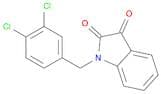
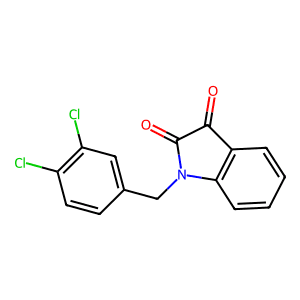
:1-(3,4-dichlorobenzyl)-1H-indole-2,3-dione
Description:
1-(3,4-Dichlorobenzyl)-1H-indole-2,3-dione, with the CAS number 79183-19-0, is a synthetic organic compound characterized by its indole structure, which is a bicyclic compound consisting of a benzene ring fused to a pyrrole ring. This compound features a dichlorobenzyl substituent at the 1-position of the indole, contributing to its unique chemical properties. It typically exhibits a solid state at room temperature and is soluble in organic solvents, reflecting its hydrophobic nature. The presence of the dichlorobenzyl group may enhance its biological activity, making it of interest in pharmaceutical research. The compound's reactivity is influenced by the electron-withdrawing nature of the chlorine atoms, which can affect its interactions with biological targets. Additionally, it may exhibit various functional properties, including potential antioxidant or anti-inflammatory activities, although specific biological effects would require empirical investigation. Safety data should be consulted for handling and exposure guidelines, as with any chemical substance.
Formula:C15H9Cl2NO2
InChI:InChI=1/C15H9Cl2NO2/c16-11-6-5-9(7-12(11)17)8-18-13-4-2-1-3-10(13)14(19)15(18)20/h1-7H,8H2
SMILES:c1ccc2c(c1)C(=O)C(=O)N2Cc1ccc(c(c1)Cl)Cl
Synonyms:- 1H-Indole-2,3-dione, 1-[(3,4-dichlorophenyl)methyl]-
- Apoptosis Activator 2
Sort by
Purity (%)
0
100
|
0
|
50
|
90
|
95
|
100
Found 4 products.
Apoptosis Activator 2
CAS:Formula:C15H9Cl2NO2Purity:98%Color and Shape:SolidMolecular weight:306.1435MDK83190
CAS:MDK83190 (Apoptosis Activator 2) is a potent apoptosis activator, induceing caspase-3 activation, PARP cleavage, and DNA fragmentation .Formula:C15H9Cl2NO2Purity:97.40% - 98%Color and Shape:Orange SolidMolecular weight:306.14Apoptosis Activator 2
CAS:Apoptosis Activator 2 (APA-2) is a protein that binds to the response element and induces apoptosis. APA-2 has proapoptotic effects and can induce apoptosis in cancer cells, as well as in other types of cells. It has been shown to interact with a number of proteins involved in cellular growth, including autophagy and protein synthesis. The biological properties of APA-2 are affected by hydrochloric acid, which promotes its activation by forming an ion pair with the protein. The NMR spectra of APA-2 have been reported to be consistent with the structure of a homodimeric protein consisting of two identical subunits.Formula:C15H9Cl2NO2Purity:Min. 95%Molecular weight:306.15 g/mol