CAS 79286-74-1
:3-Acetamidopyrrolidine
Description:
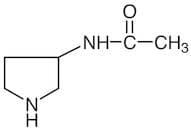
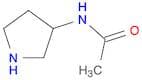
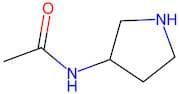
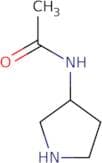
3-Acetamidopyrrolidine is a chemical compound characterized by its pyrrolidine ring structure, which is a five-membered saturated nitrogen-containing heterocycle. The presence of an acetamido group at the third position of the pyrrolidine ring contributes to its unique properties. This compound is typically a colorless to pale yellow liquid or solid, depending on its purity and form. It is soluble in polar solvents such as water and alcohols, which is indicative of its polar functional groups. 3-Acetamidopyrrolidine may exhibit biological activity, making it of interest in medicinal chemistry and pharmaceutical research. Its molecular structure allows for potential interactions with biological targets, which could lead to various applications in drug development. As with many nitrogen-containing heterocycles, it may also participate in hydrogen bonding, influencing its reactivity and interactions in chemical processes. Safety data should be consulted for handling and usage, as with any chemical substance, to ensure proper precautions are taken.
Formula:C6H12N2O
InChI:InChI=1/C6H12N2O/c1-5(9)8-6-2-3-7-4-6/h6-7H,2-4H2,1H3,(H,8,9)
SMILES:CC(=NC1CCNC1)O
Synonyms:- Acetamide, N-3-pyrrolidinyl-
- N-(Pyrrolidin-3-yl)acetamide
Sort by
Purity (%)
0
100
|
0
|
50
|
90
|
95
|
100
Found 5 products.
3-Acetamidopyrrolidine
CAS:Formula:C6H12N2OColor and Shape:Colorless to Red to Green clear liquidMolecular weight:128.18N-(Pyrrolidin-3-yl)acetamide
CAS:Formula:C6H12N2OPurity:97%Color and Shape:LiquidMolecular weight:128.17233-Acetamidopyrrolidine
CAS:3-Acetamidopyrrolidine is a molecule that is synthesized by the reaction of ethyl bromoacetate with amines. It has been shown to exhibit antibacterial activities. 3-Acetamidopyrrolidine can be used industrially as an intermediate in the synthesis of other compounds, such as nanowires and primary amines. The electrochemical method is a scalable and cost-effective way to produce 3-Acetamidopyrrolidine. This compound has been shown to be flammable when exposed to heat or flame, so should not be handled near open flames or hot surfaces.Formula:C6H12N2OPurity:Min. 95%Molecular weight:128.17 g/mol