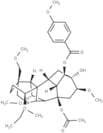
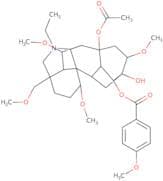
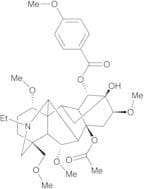
CAS 79592-91-9
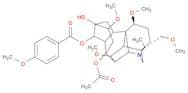
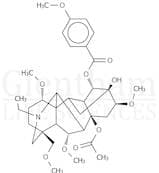
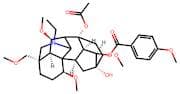
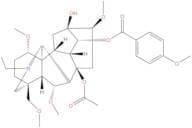
:Crassicauline A
Description:
Crassicauline A is a naturally occurring alkaloid that has garnered interest due to its unique structural features and potential biological activities. It is primarily derived from certain plant species, particularly those in the family of Asteraceae. This compound is characterized by its complex bicyclic structure, which contributes to its pharmacological properties. Crassicauline A has been studied for its potential anti-inflammatory and anticancer activities, making it a subject of interest in medicinal chemistry. Its mechanism of action may involve the modulation of various cellular pathways, although detailed studies are ongoing to fully elucidate its effects. Additionally, the compound's solubility and stability in different solvents can vary, influencing its bioavailability and efficacy in biological systems. As research continues, Crassicauline A may offer insights into new therapeutic agents, particularly in the fields of oncology and pharmacology. However, further studies are necessary to fully understand its safety profile and potential applications in medicine.
Formula:C35H49NO10
InChI:InChI=1S/C35H49NO10/c1-8-36-17-32(18-40-3)14-13-23(42-5)35-22-15-33(39)24(43-6)16-34(46-19(2)37,26(29(35)36)27(44-7)28(32)35)25(22)30(33)45-31(38)20-9-11-21(41-4)12-10-20/h9-12,22-30,39H,8,13-18H2,1-7H3/t22-,23+,24+,25-,26+,27+,28-,29-,30-,32+,33+,34-,35+/m1/s1
InChI key:InChIKey=GAZDXIGXYWVWQX-IBOHHWAHSA-N
SMILES:O(C)[C@@H]1[C@]23[C@]4([C@]5([C@@](OC(C)=O)([C@@]6([C@]2(N(CC)C[C@@](COC)([C@]3([C@H]6OC)[H])CC1)[H])[H])C[C@H](OC)[C@@](O)(C4)[C@@H]5OC(=O)C7=CC=C(OC)C=C7)[H])[H]
Synonyms:- (1Alpha,6Alpha,14Alpha,16Beta)-8-(Acetyloxy)-20-Ethyl-13-Hydroxy-1,6,16-Trimethoxy-4-(Methoxymethyl)Aconitan-14-Yl 4-Methoxybenzoate
- 2H-12,3,6a-Ethanylylidene-7,9-methanonaphth[2,3-b]azocine, aconitane-8,13,14-triol deriv.
- 3-Deoxyyunaconitine
- 8-(Acetyloxy)-20-Ethyl-13-Hydroxy-1,6,16-Trimethoxy-4-(Methoxymethyl)Aconitan-14-Yl 4-Methoxybenzoate
- Aconitane-8,13,14-triol, 20-ethyl-1,6,16-trimethoxy-4-(methoxymethyl)-, 8-acetate 14-(4-methoxybenzoate), (1α,6α,14α,16β)-
- Benzoic Acid, 4-Methoxy-, (1Alpha,6Alpha,14Alpha,16Beta)-8-(Acetyloxy)-20-Ethyl-13-Hydroxy-1,6,16-Trimethoxy-4-(Methoxymethyl)Aconitan-14-Yl Ester
- Crassicaulin A
- Crassicauline I
- Crassicauline A
Sort by
Purity (%)
0
100
|
0
|
50
|
90
|
95
|
100
Found 7 products.
8-(Acetyloxy)-20-ethyl-13-hydroxy-1,6,16-trimethoxy-4-(methoxymethyl)aconitan-14-yl 4-methoxybenzoate
CAS:Formula:C35H49NO10Purity:98%Color and Shape:SolidMolecular weight:643.7643Crassicauline A
CAS:1.Formula:C35H49NO10Purity:97.14% - 99.98%Color and Shape:SolidMolecular weight:643.76Crassicauline A
CAS:Crassicauline A is a diterpenoid alkaloid, which is a bioactive compound derived from plants of the genus Aconitum. These plants, commonly known as monkshood or wolfsbane, are native to mountainous regions and have been used historically in traditional medicine. The mode of action of Crassicauline A involves the modulation of ion channels in the nervous system. It influences the flow of sodium ions across neuronal membranes, impacting nerve impulse transmission.Formula:C35H49NO10Purity:Min. 95%Color and Shape:PowderMolecular weight:643.76 g/mol3-Deoxyyunaconitine
CAS:Controlled ProductApplications 3-Deoxyyunaconitine is a metabolite of Aconitine (A189875), a neurotoxin that binds, activates tetrodotoxin-sensitive Na+ channels and prolongs the opening of the sodium-ion channel by suppressing conformational changes.
References Derbre, S., et al.: Anal. Bioanal. Chem., 398, 1747 (2010), Li, M., et al.: J. Pharm. Biomed. Anal., 53, 1063 (2010),Formula:C35H49NO10Color and Shape:NeatMolecular weight:643.76