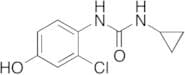
CAS 796848-79-8
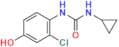
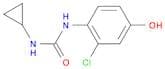
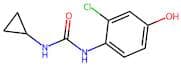
:N-(2-chloro-4-hydroxyphenyl)-N'-cyclopropyl-Urea
Description:
N-(2-chloro-4-hydroxyphenyl)-N'-cyclopropyl-urea, identified by its CAS number 796848-79-8, is a chemical compound that belongs to the class of ureas. This substance features a cyclopropyl group attached to the nitrogen atom of the urea moiety, along with a 2-chloro-4-hydroxyphenyl group, which contributes to its unique properties. The presence of the chloro and hydroxy functional groups indicates potential for hydrogen bonding and reactivity, making it of interest in various chemical applications. The compound may exhibit biological activity, potentially serving as a lead compound in pharmaceutical research. Its structural characteristics suggest it could interact with biological targets, influencing processes such as enzyme inhibition or receptor binding. Additionally, the cyclopropyl group may impart specific steric and electronic properties that affect the compound's overall behavior in chemical reactions or biological systems. As with many urea derivatives, it may also be subject to hydrolysis under certain conditions, which is an important consideration in its stability and reactivity.
Formula:C10H11ClN2O2
Synonyms:- Urea, N-(2-chloro-4-hydroxyphenyl)-N'-cyclopropyl-
- 1-(2-Chloro-4-Hydroxyphenyl)-3-Cyclopropylurea
- Lenvatinib Intermediate
- Lenvatinib Intermediate-1
Sort by
Purity (%)
0
100
|
0
|
50
|
90
|
95
|
100
Found 6 products.
Urea, N-(2-chloro-4-hydroxyphenyl)-N'-cyclopropyl-
CAS:Formula:C10H11ClN2O2Purity:97%Color and Shape:SolidMolecular weight:226.65951-(2-Chloro-4-hydroxyphenyl)-3-cyclopropylurea
CAS:1-(2-Chloro-4-hydroxyphenyl)-3-cyclopropylureaPurity:98%Molecular weight:226.66g/molLenvatinib Impurity 16
CAS:Formula:C10H11ClN2O2Color and Shape:White To Off-White SolidMolecular weight:226.66Desquinolinyl Lenvatinib
CAS:Controlled ProductApplications Desquinolinyl Lenvatinib is a metabolite of Lenvatinib (L329400) which is an orally active inhibitor of multiple receptor tyrosine kinases including VEGF, FGF and SCF receptors.
References Matsui, J., et al.: Clin. Cancer Res., 14, 5459 (2008); Gild, M., et al.: Nature Rev. Endocrinol., 7, 617 (2011)Formula:C10H11ClN2O2Color and Shape:NeatMolecular weight:226.66