![2-[2-(4,5-dihydro-1H-imidazol-2-yl)-1-phenylethyl]pyridine dihydrochloride](/_next/image/?url=https%3A%2Fstatic.cymitquimica.com%2Fcas-image%2Fthumb-webp%2F488017-2-2-45-dihydro-1h-imidazol-2-yl-1-phenylethyl-pyridine-dihydrochloride.webp&w=3840&q=75)
CAS 79689-25-1
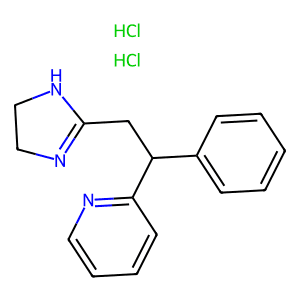
:2-[2-(4,5-dihydro-1H-imidazol-2-yl)-1-phenylethyl]pyridine dihydrochloride
Description:
2-[2-(4,5-dihydro-1H-imidazol-2-yl)-1-phenylethyl]pyridine dihydrochloride is a chemical compound characterized by its complex structure, which includes a pyridine ring and an imidazole moiety. This substance typically appears as a white to off-white crystalline solid and is soluble in water due to the presence of hydrochloride groups, which enhance its solubility. The compound may exhibit biological activity, potentially acting as a ligand or modulator in various biochemical pathways, making it of interest in medicinal chemistry and pharmacology. Its molecular structure suggests that it could interact with specific receptors or enzymes, although detailed studies would be necessary to elucidate its precise mechanisms of action. As with many chemical substances, safety data sheets should be consulted for handling and toxicity information, as well as for any specific storage requirements. Overall, this compound represents a unique combination of heterocyclic structures that may have implications in drug development and research.
Formula:C16H19Cl2N3
InChI:InChI=1/C16H17N3.2ClH/c1-2-6-13(7-3-1)14(12-16-18-10-11-19-16)15-8-4-5-9-17-15;;/h1-9,14H,10-12H2,(H,18,19);2*1H
SMILES:c1ccc(cc1)C(CC1=NCCN1)c1ccccn1.Cl.Cl
Sort by
Purity (%)
0
100
|
0
|
50
|
90
|
95
|
100
Found 3 products.
Midaglizole hydrochloride
CAS:Midaglizole hydrochloride is a peptide that can be used as a research tool to study protein interactions. It is an inhibitor of ion channels and ligand-gated ion channels, which are proteins that open or close in response to the binding of a chemical messenger (ligand). Midaglizole hydrochloride has been shown to block cell signaling and inhibit the production of prostaglandin. It has also been used in pharmacology studies as a ligand for various receptors, including neurotensin receptor 1 and dopamine receptor D1.
Formula:C16H19Cl2N3Purity:Min. 95%Molecular weight:324.2 g/molMidaglizole hydrochloride
CAS:Midaglizole hydrochloride (DG5128) is an α2-adrenoceptor antagonist with 7.4x more affinity than α1-adrenoceptors (pKi=6.28).Formula:C16H19Cl2N3Purity:99.39% - 99.82%Color and Shape:SolidMolecular weight:324.25Ref: TM-T11015
1mg54.00€5mg119.00€10mg188.00€25mg306.00€50mg416.00€100mg532.00€200mg705.00€1mL*10mM (DMSO)152.00€