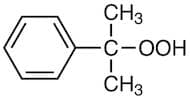
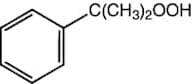
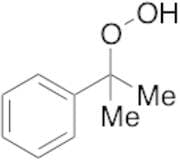
CAS 80-15-9
:Cumene hydroperoxide
Description:
Cumene hydroperoxide, with the CAS number 80-15-9, is an organic peroxide that serves as a key intermediate in the production of phenol and acetone through the cumene process. It is a colorless to pale yellow liquid that is slightly soluble in water but more soluble in organic solvents. This compound is characterized by its strong oxidizing properties, which can lead to hazardous reactions if not handled properly. Cumene hydroperoxide is sensitive to heat and shock, making it potentially explosive under certain conditions. It can decompose to form various byproducts, including cumene and other reactive species, especially when exposed to light or elevated temperatures. In terms of safety, it is classified as a hazardous material, requiring appropriate precautions during storage and handling to prevent accidental decomposition. Overall, cumene hydroperoxide plays a significant role in industrial chemistry, particularly in the synthesis of important chemical products.
Formula:C9H12O2
InChI:InChI=1S/C9H12O2/c1-9(2,11-10)8-6-4-3-5-7-8/h3-7,10H,1-2H3
InChI key:InChIKey=YQHLDYVWEZKEOX-UHFFFAOYSA-N
SMILES:C(OO)(C)(C)C1=CC=CC=C1
Synonyms:- 1-Methyl-1-phenylethyl hydroperoxide
- 1-Methyl-1-phenylethylhydroperoxide
- 2-Hydroperoxy-2-phenylpropane
- 2-Phenyl-2-propyl hydroperoxide
- 2-Phenylpropan-2-Yl Hydroperoxide
- 2-Phenylpropyl hydroperoxide
- 7-Cumyl hydroperoxide
- C 109598
- Chp 158
- Chp 5
- Chp 90
- Cu 90
- Cu 90L
- Cumen hydroperoxide
- Cumene hydroperoxide solution
- Cumenehydroperoxide
- Cumenyl hydroperoxide
- Cumol-Hydroperoxid
- Cumyl hydrogen peroxide
- Cumyl hydroperoxide
- H 80
- Hidroperoxido De Α-Α-Dimetilbencilo
- Hydrogen Peroxide - Propan-2-Ylbenzene (1:1)
- Hydroperoxide, 1-Methyl-Phenylethyl-
- Hydroperoxide, 1-methyl-1-phenylethyl
- Hydroperoxide, α,α-dimethylbenzyl
- Hydroperoxyde de α,α-dimethylbenzyle
- Hyperis
- Hyperiz
- Isopropylbenzene hydroperoxide
- Kayacumene H
- Luperox CU 80
- Luperox CU 90
- Norox CHP
- Percumyl H
- Percumyl H 18
- Percumyl H 80
- Percumyl H 90
- Peroxan CU 90L
- Ph 80
- R 239A
- Trigonox K 80
- Trigonox K 90
- Trigonox R 239A
- Trigonox R 239R
- Trigonox?K
- alpha,alpha-Dimethylbenzyl hydroperoxide
- Α,Α-Dimethylbenzyl Hydroperoxide
- α,α-Dimethylbenzylhydroperoxid
- α-Cumene hydroperoxide
- α-Cumyl hydroperoxide
- See more synonyms
Sort by
Purity (%)
0
100
|
0
|
50
|
90
|
95
|
100
Found 3 products.
Cumene Hydroperoxide (contains ca. 20% Aromatic Hydrocarbon)
CAS:Formula:C9H12O2Color and Shape:Colorless to Almost colorless clear liquidMolecular weight:152.19Cumyl hydroperoxide, tech. 80%
CAS:Cumene hydroperoxide, tech. 80%, Thermo Scientific ChemicalsFormula:C9H12O2Purity:80%Color and Shape:Liquid, Clear colorless to pale yellowMolecular weight:152.19Cumene Hydroperoxide (80%, Technical grade)
CAS:Controlled ProductStability Light Sensitive
Applications Cumene Hydroperoxide is an oxidant (1) used in the preparation of polystyrene nanocapsules. Through the study of melatonin it has been observed to promote lipid oxidation and inhibit protein synthesis. Drinking water contaminant candidate list 3 (CCL 3) compound as per United States Environmental Protection Agency (EPA), environmental, and food contaminants.
E0
References 1. Eren, O. et al.: Clin. Biochem. 2005 Dec;38(12):1103-112. Munoz, M. et a/l.: J. Cell. Biochem. 2017 Jan;118(1):182-190.Formula:C9H12O2Color and Shape:NeatMolecular weight:152.19