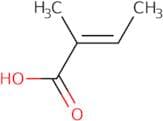
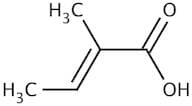
CAS 80-59-1
:Tiglic acid
Description:
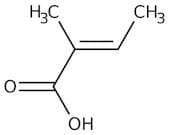
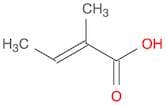
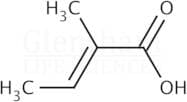
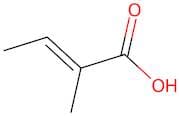
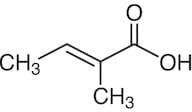
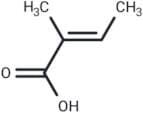
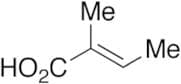
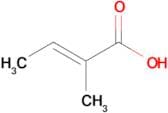
Tiglic acid, also known as 2-methyl-2-butenoic acid, is an unsaturated carboxylic acid characterized by its branched structure and the presence of a double bond in its carbon chain. It has the molecular formula C5H8O2 and features a carboxyl group (-COOH) that imparts acidic properties. Tiglic acid is a colorless liquid at room temperature and has a distinctive, pungent odor. It is soluble in organic solvents such as ethanol and ether but has limited solubility in water due to its hydrophobic alkyl groups. This compound is primarily used in organic synthesis and as an intermediate in the production of various chemicals, including fragrances and pharmaceuticals. Additionally, tiglic acid can be derived from natural sources, such as certain essential oils. Its reactivity is influenced by the presence of the double bond, making it a useful building block in various chemical reactions, including polymerization and esterification. Safety precautions should be taken when handling tiglic acid, as it can be irritating to the skin and eyes.
Formula:C5H8O2
InChI:InChI=1S/C5H8O2/c1-3-4(2)5(6)7/h3H,1-2H3,(H,6,7)/b4-3+
InChI key:InChIKey=UIERETOOQGIECD-ONEGZZNKSA-N
SMILES:C(\C(O)=O)(=C/C)/C
Synonyms:- (2E)-2-Methyl-2-butenoic acid
- (E)-2,3-Dimethylacrylic acid
- (E)-2-Methyl-2-butenoic acid
- (E)-2-Methylcrotonic acid
- (E)-α-Methylcrotonic acid
- 2-Butenoic acid, 2-methyl-, (2E)-
- 2-Butenoic acid, 2-methyl-, (E)-
- Cevadic acid
- Crotonic acid, 2-methyl-, (E)-
- NSC 44235
- NSC 8999
- Tiglic acid
- Tiglinic acid
- trans-2-Methyl-2-butenoic acid
- trans-2-Methylcrotonic acid
- See more synonyms
Sort by
Purity (%)
0
100
|
0
|
50
|
90
|
95
|
100
Found 12 products.
Tiglic acid, 97+%
CAS:This Thermo Scientific Chemicals brand product was originally part of the Alfa Aesar product portfolio. Some documentation and label information may refer to the legacy brand. The original Alfa Aesar product / item code or SKU reference has not changed as a part of the brand transition to Thermo SciFormula:C5H8O2Purity:97+%Color and Shape:White to cream to pale brown, Crystals or powder or crystalline powderMolecular weight:100.12Ref: IN-DA0035P7
5kgTo inquire1g21.00€5g21.00€10g24.00€25g25.00€50g31.00€100g50.00€250g80.00€500g120.00€1kg160.00€trans-2,3-Dimethylacrylic acid
CAS:Formula:C5H8O2Purity:≥ 98.0%Color and Shape:White to off-white crystalline powder or crystalsMolecular weight:100.12Tiglic Acid
CAS:Formula:C5H8O2Purity:>98.0%(GC)(T)Color and Shape:White to Almost white powder to crystalMolecular weight:100.12Tiglic acid
CAS:Tiglic acid (Cevadic acid) is a thick, syrupy poisonous liquid, C5H8O2, derived from croton oil, having a spicy odor and used in making perfumes and flavoringFormula:C5H8O2Purity:99.99%Color and Shape:Triclinic Plates Rods From Water Density As Water And Slightly Soluble In Water May Burn If Heated To High Temperatures May SeverelyMolecular weight:100.12Tiglic Acid
CAS:Applications Tiglic acid is the stable isomer of angelic acid. Tiglic acid was found as glyceride in croton oil, as butyl ester in the oil of the Roman camomile, and as geranyl tiglate in oil of geranium. Tiglic acid is formed during the charcoaling of maple wood.
Not a dangerous good if item is equal to or less than 1g/ml and there is less than 100g/ml in the package
References Bueding, et al.: J. Biol. Chem., 202, 505 (1953),Formula:C5H8O2Color and Shape:NeatMolecular weight:100.12Tiglic Acid
CAS:Formula:C5H8O2Purity:98%Color and Shape:Liquid, No data available.Molecular weight:100.117Tiglic acid
CAS:Tiglic acid is a sodium salt that can be synthesized in an asymmetric synthesis. It is a white crystalline powder with a melting point of 190-191°C. Tiglic acid has been shown to increase the activity of cinchonidine, which is a compound often used to treat eye disorders and chronic arthritis. Tiglic acid also has the ability to bind to fatty acids, which may be due to hydrogen bonding interactions. In vitro assays have shown that tiglic acid's antimicrobial properties are related to its ability to cause cell lysis by interacting with fatty acids on the cell membrane.Formula:C5H8O2Purity:Min. 95%Color and Shape:PowderMolecular weight:100.12 g/molTiglic Acid extrapure, 98%
CAS:Formula:C5H8O2Purity:min. 98%Color and Shape:White to beige, Powder, ClearMolecular weight:100.12