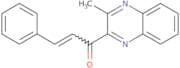
CAS 80109-63-3
:Desoxyquinocetone
Description:
Desoxyquinocetone, identified by its CAS number 80109-63-3, is a chemical compound that belongs to the class of quinones. It is characterized by its structural features, which typically include a quinone moiety, contributing to its reactivity and potential applications in various fields, including pharmaceuticals and organic synthesis. The compound may exhibit properties such as being a yellow to orange solid, with solubility in organic solvents, which is common for many quinone derivatives. Its reactivity can be attributed to the presence of carbonyl groups, making it a potential electrophile in chemical reactions. Desoxyquinocetone may also possess biological activity, although specific details regarding its pharmacological effects or toxicity are less commonly documented. As with many chemical substances, handling should be conducted with care, adhering to safety protocols to mitigate any risks associated with exposure. Overall, desoxyquinocetone represents a compound of interest in both synthetic chemistry and potential therapeutic applications.
Formula:C18H14N2O
InChI:InChI=1S/C18H14N2O/c1-13-18(20-16-10-6-5-9-15(16)19-13)17(21)12-11-14-7-3-2-4-8-14/h2-12H,1H3
InChI key:InChIKey=MWUVOSGDEVWDFA-UHFFFAOYSA-N
SMILES:C(C=CC1=CC=CC=C1)(=O)C2=NC3=C(N=C2C)C=CC=C3
Synonyms:- 1-(3-Methyl-2-quinoxalinyl)-3-phenyl-2-propen-1-one
- Desoxyquinocetone
- 2-Propen-1-one, 1-(3-methyl-2-quinoxalinyl)-3-phenyl-
Sort by
Purity (%)
0
100
|
0
|
50
|
90
|
95
|
100
Found 2 products.
Desoxyquinocetone
CAS:Controlled Product<p>Applications Desoxyquinocetone is a metabolite of the veterinay drug Quinocetone.<br>References Li, Y. et al.: J. AOAC Int., 91, 1494 (2008); Liu, Z.-Y. et al.: Anal. Bioanal. Chem., 396, 1259 (1271);<br></p>Formula:C18H14N2OColor and Shape:NeatMolecular weight:274.32Desoxyquinocetone
CAS:<p>Desoxyquinocetone is a specific antibody that recognizes and binds to the quinoline ring of desoxyquinocetone. It has low bioavailability in the body, which is determined by the structural formula. The detection sensitivity of this antibody is high, and it can be used in tissue samples. This antibody also has a chromatographic method for determining carbonyl reduction and a monoclonal antibody for hybridoma cell strain. The specificity of this antibody is determined by the target tissue and strain, as well as its chromatographic method for detecting antigen.</p>Formula:C18H14N2OPurity:Min. 95%Molecular weight:274.3 g/mol