CAS 8017-16-1
:Polyphosphoric acids
- Acides polyphosphoriques
- Acidos Polifosforicos
- Condensed phosphoric acids
- Phospholeum
- Phosphoric acid, poly-
- Polyphosphoric acid
- Polyphosphorsauren
- Ppa 116
- Ppa 80
- Ppa 82
- Ppa 84
- Ppa 85
- Ppa 88
- Super Phos 105
- Polyphosphoric acids
- PolyphosphoricacidPOviscousliq
- PPA
- Tetraphosphoric acid
- Superphosphoric Acid
- Polyphosphoricacid,ca84%(asphosphoruspentoxide)
- Polyphosphoric acid (83% P2O5)
- Polyphosphorsuren
- condensedphosphoricacid
- condensedphosphoricacid(non-specificname)
- Phosphoric acids, super-or poly-
- acidesuperphosphorique
- acidepolyphosphorique
- Polyphosphoic Acid
- POLYPHOSPHORIC ACID FOR SYNTHESIS
- POLYPHOSPHORIC ACID , 84% MIN.
- Polyphosphoric acid, > 84% phosphate (as P2O5), pure
- POLYPHOSPHORIC ACID REAGENT GRADE 115&
- Polyphosphoric acid PPA 105% , 115%, 116%
- See more synonyms
Polyphosphoric acid, ca 84% (as phosphorus pentoxide)
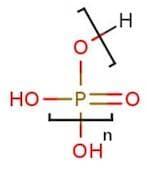
CAS:Polyphosphoric acid is used as a dehydrating agent, cyclizing agent, acylating agent, analytical reagent and as a ring closing reagent. It is used in the production of phosphate esters, acid phosphates and pharmaceuticals. It is involved in metal treatment and as an asphalt and a bitumen additive. FFormula:(HO3P)nPurity:84%Color and Shape:Clear colorless to pale yellow, Viscous liquidPolyphosphoric acid (83% P₂O₅)
CAS:Polyphosphoric acid (83% P2O5)
Formula:H3PO4·P2O5Purity:83%Color and Shape:viscous liq.Molecular weight:239.95Polyphosphoric Acid
CAS:Controlled ProductApplications Polyphosphoric Acid is a ligand used as an analytical tool to image nanoparticles through photon emission topography. Used also in the synthesis of pharmaceuticals.
References Peng J. et al.: Biomat., 37, 9535 (2013);Formula:HnPnO3nColor and Shape:NeatPolyphosphoric acid
CAS:Controlled ProductPolyphosphoric acid is a polymerase chain reaction (PCR) reagent that is used as a potent antagonist. It reacts with metal ions to form polymers, which can be used in the synthesis of polymers. Polyphosphoric acid has been shown to react with acyl halides to produce acylated polymers and with hydroxyl groups to produce polymers containing phosphonic acid groups. Polyphosphoric acid also reacts with carbonyl groups, forming polyphosphates. FT-IR spectroscopy has been used to study the chemical interactions of polyphosphoric acid with test samples. The FT-IR spectrum of pure polyphosphoric acid shows peaks at 1601, 1528, 1450, 1248 cm-1, corresponding to the carbonyl group; 1704 cm-1 corresponding to the hydrogen bond; and 3368 cm-1 corresponding to the hydroxyl group.
Purity:Min. 95%Color and Shape:Clear LiquidPolyphosphoric Acid extrapure, 83-87% P2O5
CAS:Formula:HnPnO3nPurity:~115%Color and Shape:Clear, Colourless, Syrupy liquid