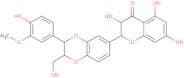
CAS 802918-57-6
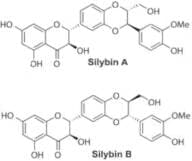
:Silybin
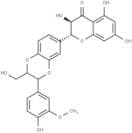
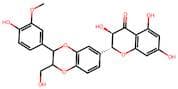
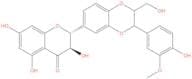
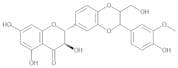
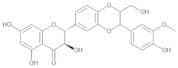
- 4H-1-Benzopyran-4-one, 2-[2,3-dihydro-3-(4-hydroxy-3-methoxyphenyl)-2-(hydroxymethyl)-1,4-benzodioxin-6-yl]-2,3-dihydro-3,5,7-trihydroxy-, (2R,3R)-
- Silybin A,B (Mixture)
- Silybin (Mixture of Diastereomers)
Silybin
CAS:Silybin analytical standard provided with chromatographic purity, to be used as reference material for qualitative determination.Formula:C25H22O10Purity:(HPLC) ≥95% (total of isomers)Color and Shape:PowderMolecular weight:482.45Silybin
CAS:Silybin is a flavonoid from Silybum that inhibits P-gp-assisted extracellular efflux, inhibits cytochrome P450 enzymes,anti-inflammatory, Hepatoprotective.Formula:C25H22O10Purity:98.12%Color and Shape:SolidMolecular weight:482.44Silybin
CAS:Silymarin (SIL), a standardized plant extract containing about 60% polyphenole silibinin, is used as a hepatoprotective agent, it retards collagen accumulation in early and advanced biliary fibrosis secondary to complete bile duct obliteration in rats, it also may play a role in the therapy of (alcoholic) liver cirrhosis.[1,2]Formula:C25H22O10Purity:95%~99%Color and Shape:White powderMolecular weight:482.441Silybin (Mixture of Silybin A and B)
CAS:Formula:C25H22O10Color and Shape:NeatMolecular weight:482.44Silybin (a + b mixture)
CAS:Oxygen-heterocyclic compoundFormula:C25H22O10Purity:≥ 95.0 % (HPLC)Color and Shape:PowderMolecular weight:482.44Silybin A,B (mixture)
CAS:Applications Hepatoprotectant. In nature, the flavonolignan Silybin occurs as a mixture of two diastereomers, Silybin A and Silybin B.
References Xu, P., et al.: Int. J. Biol. Macromol., 47, 654 (2010), Ravichandran, K., et al.: Clin. Canc. Res., 16, 4595 (2010), Derbre, S., et al.: Anal. Bioanal. Chem., 398, 1747 (2010),Formula:C25H22O10Color and Shape:Light Yellow To BrownMolecular weight:482.44(2R,3R)-3,5,7-Trihydroxy-2-[3-(4-hydroxy-3-methoxyphenyl)-2-(hydroxymethyl)-2,3-dihydro-1,4-benzodioxin-6-yl]-2,3-dihydrochromen-4-o ne
CAS:(2R,3R)-3,5,7-Trihydroxy-2-[3-(4-hydroxy-3-methoxyphenyl)-2-(hydroxymethyl)-2,3-dihydro-1,4-benzodioxin-6-yl]-2,3-dihydrochromen-4-o ne is a natural compound that has been shown to have cytotoxic activity against murine hepatoma cells and human skin cancer cells. It also has antiinflammatory properties and inhibits acetylcholinesterase. This compound may be used as an adjuvant treatment for autoimmune diseases or in the preparation of primary cells for mitochondrial functions studies.
Formula:C25H22O10Purity:Min. 95%Molecular weight:482.4 g/mol