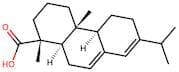
CAS 8050-09-7
:Rosin
Description:
Rosin, also known as colophony, is a natural resin obtained from pine trees, particularly from the species Pinus. It is characterized by its solid, brittle form at room temperature and is typically amber to yellow in color. Rosin is composed primarily of various resin acids, including abietic acid, and has a complex mixture of terpenes. It is insoluble in water but soluble in organic solvents such as alcohol, ether, and turpentine. Rosin exhibits a range of properties, including a relatively high melting point and a sticky texture when heated. It is widely used in various applications, including as a flux in soldering, in the production of inks and adhesives, and as a grip enhancer in sports. Additionally, rosin is utilized in the manufacture of varnishes and as a component in some food packaging materials. Its chemical stability and non-toxic nature make it a versatile substance in both industrial and artistic applications.
Formula:Unspecified
InChI:InChI=1/C20H30O2/c1-13(2)14-6-8-16-15(12-14)7-9-17-19(16,3)10-5-11-20(17,4)18(21)22/h7,12-13,16-17H,5-6,8-11H2,1-4H3,(H,21,22)/t16?,17?,19-,20?/m1/s1
Synonyms:- Cg-Ww
- Cg-X
- Colofonia
- Colophane
- Colophonium
- Colophony
- Flygo
- Highrosin
- Kolophonium
- Optika
- Rr-Chx
- Solros
- Rosin WW
- Hongkong Rosin WW
- Rosin
- Rosin Solder Flux Fume
- Rosin
- Pine rosin
- Yellow resin
- Wood rosin
- (4aR)-7-isopropyl-1,4a-dimethyl-2,3,4,4b,5,6,10,10a-octahydrophenanthrene-1-carboxylic acid
- See more synonyms
Sort by
Purity (%)
0
100
|
0
|
50
|
90
|
95
|
100
Found 5 products.
Rosin
CAS:Rosin is an ingredient in printing inks, photocopying and laser printing paper, varnishes, adhesives (glues), soap, paper sizing, soda, soldering fluxes and sealing wax. It can be used as a glazing agent in medicines and chewing gum. In industry, rosin is a flux used in soldering. A mixture of pitchFormula:C20H30O2Color and Shape:Solid, Cream to yellow to brownMolecular weight:302.46Gum Rosin
CAS:Controlled ProductApplications Gum Rosin and its derivatives can be used as microencapsulating materials, film forming agents, and binding agents in formulation of tablets. They are also used in the formulation of cosmetics and the bases of chewing gum. Gum Rosin extracts are also commonly used to treat burns.
References Kumar, Shobhit., et al.: Polimery-w Med., 43(2), 45-8 (2013); Clark, S. P., et al.: Phytother. Res., 28(2), 252-60 (2014)Formula:C5H8O5Color and Shape:Neat