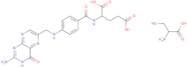
![L-Glutamic acid, N-[4-[[(2-amino-3,4-dihydro-4-oxo-6-pteridinyl)methyl]amino]benzoyl]-, mixt. with…](/_next/image/?url=https%3A%2Fstatic.cymitquimica.com%2Fcas-image%2Fthumb-webp%2F339387-l-glutamic-acid-n-4-2-amino-34-dihydro-4-oxo-6-pteridinyl-methyl-amino-benzoyl-mixt-with-4r-3-acetyl-4-thiazolidinecarboxylic-acid.webp&w=3840&q=75)
CAS 8064-47-9
:L-Glutamic acid, N-[4-[[(2-amino-3,4-dihydro-4-oxo-6-pteridinyl)methyl]amino]benzoyl]-, mixt. with (4R)-3-acetyl-4-thiazolidinecarboxylic acid
Description:
L-Glutamic acid, N-[4-[[(2-amino-3,4-dihydro-4-oxo-6-pteridinyl)methyl]amino]benzoyl]-, mixed with (4R)-3-acetyl-4-thiazolidinecarboxylic acid, is a complex chemical compound that exhibits characteristics typical of amino acids and their derivatives. This substance is likely to be involved in biochemical processes, potentially acting as a neurotransmitter or a precursor in metabolic pathways. The presence of pteridine and thiazolidine moieties suggests that it may have specific biological activities, possibly related to enzyme function or cellular signaling. The compound's structure indicates it may participate in interactions with proteins or nucleic acids, influencing various physiological functions. Additionally, the mixture may exhibit unique solubility and stability properties, which could be relevant for its application in pharmaceuticals or biochemistry. As with many amino acid derivatives, it may also have implications in nutrition or therapeutic contexts, particularly in relation to its role in protein synthesis or as a metabolic intermediate.
Formula:C19H19N7O6·C6H9NO3S
InChI:InChI=1S/C19H19N7O6.C6H9NO3S/c20-19-25-15-14(17(30)26-19)23-11(8-22-15)7-21-10-3-1-9(2-4-10)16(29)24-12(18(31)32)5-6-13(27)28;1-4(8)7-3-11-2-5(7)6(9)10/h1-4,8,12,21H,5-7H2,(H,24,29)(H,27,28)(H,31,32)(H3,20,22,25,26,30);5H,2-3H2,1H3,(H,9,10)/t12-;5-/m00/s1
InChI key:InChIKey=VYRZTJJEGHJETR-OEFIRVHCSA-N
SMILES:C(O)(=O)[C@H]1N(C(C)=O)CSC1.O=C1C=2C(NC=C(CNC3=CC=C(C(N[C@@H](CCC(O)=O)C(O)=O)=O)C=C3)N2)=NC(N)=N1
Synonyms:- 4-Thiazolidinecarboxylic acid, 3-acetyl-, (4R)-, mixt. contg.
- L-Glutamic acid, N-[4-[[(2-amino-3,4-dihydro-4-oxo-6-pteridinyl)methyl]amino]benzoyl]-, mixt. with (4R)-3-acetyl-4-thiazolidinecarboxylic acid
- L-Glutamic acid, N-[4-[[(2-amino-1,4-dihydro-4-oxo-6-pteridinyl)methyl]amino]benzoyl]-, mixt. with (4R)-3-acetyl-4-thiazolidinecarboxylic acid
- 4-Thiazolidinecarboxylic acid, 3-acetyl-, (R)-, mixt. contg.
- L-Glutamic acid, N-[4-[[(2-amino-1,4-dihydro-4-oxo-6-pteridinyl)methyl]amino]benzoyl]-, mixt. with (R)-3-acetyl-4-thiazolidinecarboxylic acid
Sort by
Purity (%)
0
100
|
0
|
50
|
90
|
95
|
100
Found 3 products.
Folcysteine
CAS:Folcysteine, a cysteine derivative, may fight tumors, aids in DNA synthesis, repair, methylation, and acts as a folate cofactor.Formula:C25H28N8O9SColor and Shape:SolidMolecular weight:616.60Folcysteine
CAS:Controlled ProductApplications A cysteine derivative as potential antitumor agent. (A609645)A vitamin needed to synthesize DNA, conduct DNA repair and methylate DNA, it also acts as a cofactor in biological reactions involving folate. (F680300)
References Paul, B., et al.: J. Med. Chem., et al.: 19, 1002 (1976), Xu, L., et al.: Mol. Pharm., 7, 1311 (2010), Everette, J., et al.: J. Agric. Food Chem., 58, 8139 (2010), Alshatwi, A., et al.: Food, Chem., Toxicol., 48, 1881 (2010), McKay, D., et al.: Nut. J., 9 (2010),Formula:C19H19N7O6·C6H9NO3SColor and Shape:YellowMolecular weight:616.61Folcysteine
CAS:Folcysteine is an enzyme inhibitor that inhibits the synthesis of protein and DNA. It has been shown to have a high affinity for folate receptors, which are involved in the growth of cells. Folcysteine is used as a diagnostic tool for diseases such as rheumatoid arthritis, osteoarthritis, and psoriasis. It can be used in vivo or in vitro to detect the presence of specific antibodies in blood serum or tissue extracts. This drug has also been shown to inhibit transcription-polymerase chain reactions (PCR) and polymerase chain reactions (PCR). The use of folcysteine as a therapeutic agent is limited due to its toxicity, but it may be useful for research purposes.Formula:C22H26N8O8SPurity:Min. 95%Molecular weight:562.6 g/mol