CAS 80866-95-1
:3-(1H-Pyrrol-1-ylmethyl)pyridine
Description:
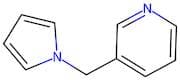
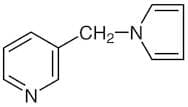
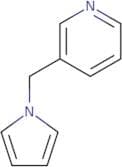
3-(1H-Pyrrol-1-ylmethyl)pyridine, with the CAS number 80866-95-1, is an organic compound characterized by its pyridine and pyrrole functional groups. This substance features a pyridine ring substituted with a 1H-pyrrole moiety at the 3-position, which contributes to its unique chemical properties. It is typically a colorless to pale yellow liquid or solid, depending on its purity and form. The compound exhibits moderate solubility in polar solvents, such as water and alcohols, due to the presence of nitrogen atoms in both the pyridine and pyrrole rings, which can engage in hydrogen bonding. Its structure suggests potential applications in medicinal chemistry, particularly in the development of pharmaceuticals, as both pyridine and pyrrole derivatives are known for their biological activity. Additionally, the compound may participate in various chemical reactions, including electrophilic substitutions and coordination with metal ions, making it of interest in coordination chemistry and materials science. Safety data should be consulted for handling and storage, as with all chemical substances.
Formula:C10H10N2
InChI:InChI=1S/C10H10N2/c1-2-7-12(6-1)9-10-4-3-5-11-8-10/h1-8H,9H2
InChI key:InChIKey=PJVWPGGKILHMKW-UHFFFAOYSA-N
SMILES:C(C=1C=CC=NC1)N2C=CC=C2
Synonyms:- 3-(1H-Pyrrol-1-ylmethyl)pyridine
- Pyridine, 3-(1H-pyrrol-1-ylmethyl)-
- 3-(Pyrrol-1-ylmethyl)pyridine
Sort by
Purity (%)
0
100
|
0
|
50
|
90
|
95
|
100
Found 5 products.
3-[(1H-pyrrol-1-yl)methyl]pyridine
CAS:Formula:C10H10N2Purity:97%Color and Shape:LiquidMolecular weight:158.19983-(1-Pyrrolylmethyl)pyridine
CAS:Formula:C10H10N2Purity:>97.0%(GC)(T)Color and Shape:White to Yellow to Orange powder to crystalMolecular weight:158.203-(Pyrrol-1-ylmethyl)pyridine
CAS:Formula:C10H10N2Purity:≥97%Color and Shape:SolidMolecular weight:158.2043-(1-Pyrrolylmethyl)pyridine
CAS:3-(1-Pyrrolylmethyl)pyridine (3PMP) is a pyrrole that can be used as an electrocatalyst in polymerization reactions. The catalytic activity of 3PMP has been studied by electrochemical impedance spectroscopy and voltammetry. 3PMP is also a good electron donor because of its ability to form a stable radical cation at the electrode. This redox potential may be due to the presence of pyridine nitrogen, which is able to form strong hydrogen bonds with other molecules. 3PMP has also been shown to have good transport properties and can be used for copolymerization with other monomers, such as tetraphenylporphine, leading to an exponential increase in the number of polymer chains formed.Formula:C10H10N2Purity:Min. 95%Molecular weight:158.2 g/mol
![3-[(1H-pyrrol-1-yl)methyl]pyridine](/_next/image/?url=https%3A%2Fstatic.cymitquimica.com%2Fproducts%2FIN%2Fthumb%2FDA003IA3.jpg&w=3840&q=75)