CAS 80935-77-9
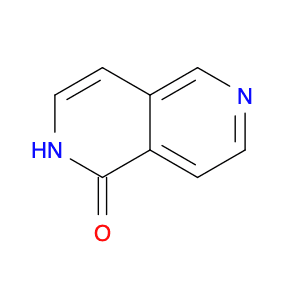
:2,6-Naphthyridin-1(2H)-one
Description:
2,6-Naphthyridin-1(2H)-one, with the CAS number 80935-77-9, is a heterocyclic organic compound characterized by a fused bicyclic structure containing nitrogen atoms in the ring system. This compound features a naphthyridine core, which consists of a pyridine ring fused to another ring, contributing to its aromatic properties. The presence of the carbonyl group (C=O) at the 1-position of the naphthyridine structure classifies it as a ketone, specifically a 1(2H)-one. This compound is typically characterized by its potential biological activity, making it of interest in medicinal chemistry and drug development. It may exhibit various pharmacological properties, including antimicrobial or anticancer activities, due to its ability to interact with biological targets. Additionally, 2,6-Naphthyridin-1(2H)-one may be utilized in synthetic organic chemistry as an intermediate in the synthesis of more complex molecules. Its solubility, stability, and reactivity can vary depending on the specific conditions and solvents used in experiments.
Formula:C8H6N2O
InChI:InChI=1/C8H6N2O/c11-8-7-2-3-9-5-6(7)1-4-10-8/h1-5H,(H,10,11)
SMILES:c1c[nH]c(=O)c2ccncc12
Synonyms:- 2,6-Naphthyridin-1-ol
Sort by
Purity (%)
0
100
|
0
|
50
|
90
|
95
|
100
Found 4 products.
2,6-Naphthyridin-1(2H)-one
CAS:Formula:C8H6N2OPurity:97%Color and Shape:SolidMolecular weight:146.14602,6-NAPHTHYRIDIN-1(2H)-ONE
CAS:Formula:C8H6N2OPurity:95%Color and Shape:SolidMolecular weight:146.1492,6-Naphthyridin-1(2H)-one
CAS:2,6-Naphthyridin-1(2H)-one is a potent and selective inhibitor of the chemokine receptor CXCR4. It is a novel and innovative compound that has been shown to have neuropathic pain activity in animal models. This agent has also been shown to inhibit the growth of cancer cells in vitro. The substitution pattern on this molecule may be responsible for its binding affinity to CXCR4 receptors as well as its selectivity over other chemokine receptors. 2,6-Naphthyridin-1(2H)-one has been shown to be an antagonist of the chemokine receptor CXCR4, which may be beneficial for treatment of chronic inflammatory diseases or cancer.
Formula:C8H6N2OPurity:Min. 95%Molecular weight:146.15 g/mol