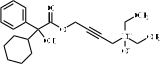
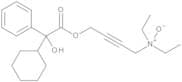
CAS 80976-68-7
:4-(diethylnitroryl)but-2-yn-1-yl cyclohexyl(hydroxy)phenylacetate
Description:
4-(Diethylnitroryl)but-2-yn-1-yl cyclohexyl(hydroxy)phenylacetate, with the CAS number 80976-68-7, is a complex organic compound characterized by its unique structural features. It contains a but-2-yn-1-yl moiety, which contributes to its alkyne functionality, and a cyclohexyl group that adds to its hydrophobic characteristics. The presence of a hydroxy group on the phenylacetate portion suggests potential for hydrogen bonding, which can influence its solubility and reactivity. The diethylnitroryl group indicates the presence of nitro functional groups, which can enhance the compound's reactivity and may impart specific electronic properties. This compound may exhibit interesting biological activities due to its structural complexity, making it a candidate for further research in medicinal chemistry or materials science. Its synthesis and applications would likely involve considerations of its stability, reactivity, and interactions with other chemical species. Overall, this compound represents a fascinating example of organic chemistry with potential implications in various fields.
Formula:C22H31NO4
InChI:InChI=1/C22H31NO4/c1-3-23(26,4-2)17-11-12-18-27-21(24)22(25,19-13-7-5-8-14-19)20-15-9-6-10-16-20/h5,7-8,13-14,20,25H,3-4,6,9-10,15-18H2,1-2H3
SMILES:CCN(=O)(CC)CC#CCOC(=O)C(c1ccccc1)(C1CCCCC1)O
Sort by
Purity (%)
0
100
|
0
|
50
|
90
|
95
|
100
Found 4 products.
Oxybutynin N-Oxide 90%
CAS:Controlled ProductApplications A metabolite of Oxybutynin.
References Hughes, K., et al.: Xenobiotica, 22, 859 (1992), Oki, T., et al.: Biol. Pharm. Bull., 24, 491 (2001), Fetscher, C., et al.: Br. J. Pharmacol., 136, 64 (2002), Zobrist, R., et al.: Pharm. Res., 20, 103 (2003)Formula:C22H31NO4Purity:90%Color and Shape:NeatMolecular weight:373.49Oxybutynin N-oxide
CAS:Oxybutynin N-oxide is a synthetic drug that belongs to the class of antispasmodics. It inhibits bladder contractions by blocking acetylcholine receptors. Oxybutynin N-oxide is metabolized in rat liver microsomes and the metabolic conversion yields oxybutynin and oxobutynin as the major metabolites, although other metabolites such as n-oxides are also observed. The metabolic conversion is controlled by cytochrome P450 enzymes. The oral bioavailability of oxybutynin N-oxide is low due to its low solubility in water and lack of a charged functional group in its structure, which makes it a poor substrate for drug transporters. The chemical stability of oxybutynin N-oxide has been shown to be high, even at elevated temperatures or when it is exposed to light or air. Oxybutynin N-oxide is not absorbed orally and must be administered intravenously or by rectal suppository.Formula:C22H31NO4Purity:90%MinMolecular weight:373.49 g/mol