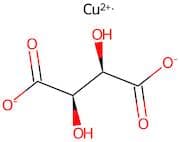
CAS 815-82-7
:Cupric tartrate
Description:
Cupric tartrate, also known as copper(II) tartrate, is a coordination compound formed from copper and tartaric acid. It typically appears as a blue-green crystalline solid, reflecting the presence of copper ions. The compound is soluble in water, which allows it to participate in various chemical reactions and applications. Cupric tartrate is often used in organic synthesis, as a catalyst, and in the production of pigments. Its coordination complex features copper in a +2 oxidation state, coordinated by tartrate ligands, which can influence its reactivity and stability. Additionally, cupric tartrate has applications in the field of agriculture as a fungicide and in the food industry as a food additive, although its use is regulated due to potential toxicity at high concentrations. Safety precautions should be taken when handling this compound, as copper salts can be harmful if ingested or inhaled. Overall, cupric tartrate is a versatile compound with significant relevance in both industrial and laboratory settings.
Formula:C4H6O6·Cu
InChI:InChI=1S/C4H6O6.Cu/c5-1(3(7)8)2(6)4(9)10;/h1-2,5-6H,(H,7,8)(H,9,10);/t1-,2-;/m1./s1
InChI key:InChIKey=XIPWCAOMSIUHSL-ZVGUSBNCSA-N
SMILES:[C@@H]([C@H](C(O)=O)O)(C(O)=O)O.[Cu]
Synonyms:- Butanedioic acid, 2,3-dihydroxy- (2R,3R)-, copper(2+) salt (1:1)
- Butanedioic acid, 2,3-dihydroxy- [R-(R*,R*)]-, copper(2+) salt (1:1)
- Copper(II) tartrate
- Copper(II) tartrate hydrate
- Copper, compd. with tartaric acid
- Coppertartratehydratebluegreenxtl
- NSC 112251
- Tartaric acid cupric salt
- Tartaric acid, copper(2+) salt (1:1), (+)-
- copper(2+) (2R,3R)-2,3-dihydroxybutanedioate
- Cupric tartrate
Sort by
Purity (%)
0
100
|
0
|
50
|
90
|
95
|
100
Found 2 products.