CAS 82-89-3
:Prodigiosin
Description:
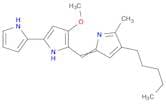
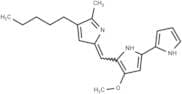
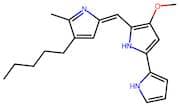
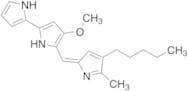
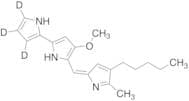
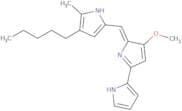
Prodigiosin is a red, pigmented compound produced by certain bacteria, notably *Serratia marcescens*. It is classified as a tripyrrole alkaloid and is known for its striking red color, which is attributed to its unique chemical structure comprising three pyrrole rings linked by methylene bridges. Prodigiosin exhibits a range of biological activities, including antibacterial, antifungal, and antiprotozoal properties, making it of interest in pharmaceutical research. Its mechanism of action is thought to involve interference with cellular processes, such as the inhibition of cell division and induction of apoptosis in certain cancer cells. Additionally, prodigiosin has been studied for its potential as an immunosuppressive agent and its role in microbial communication. The compound is soluble in organic solvents but has limited solubility in water, which can affect its bioavailability. Due to its diverse biological activities and potential applications, prodigiosin continues to be a subject of scientific investigation in various fields, including microbiology and medicinal chemistry.
Formula:C20H25N3O
InChI:InChI=1S/C20H25N3O/c1-4-5-6-8-15-11-16(22-14(15)2)12-19-20(24-3)13-18(23-19)17-9-7-10-21-17/h7,9-13,21,23H,4-6,8H2,1-3H3
InChI key:InChIKey=SZXDNGVQRDTJSD-UHFFFAOYSA-N
SMILES:C(C1=C(OC)C=C(N1)C2=CC=CN2)=C3C=C(CCCCC)C(C)=N3
Synonyms:- 2,2'-Bi-1H-pyrrole, 4-methoxy-5-((5-methyl-4-pentyl-2H-pyrrol-2-ylidene)methyl)- (9CI)
- 2,2'-Bipyrrole, 4-methoxy-5-((5-methyl-4-pentyl-2H-pyrrol-2-ylidene)methyl)-
- 2,2'-Bipyrrole, 4-methoxy-5-((5-methyl-4-pentyl-2H-pyrrol-2-ylidene)methyl)-(VAN) (8CI)
- 2,2′-Bi-1H-pyrrole, 4-methoxy-5-[(5-methyl-4-pentyl-2H-pyrrol-2-ylidene)methyl]-
- 2-Methyl-3-amyl-6-methoxyprodigiosene
- 4-Methoxy-5-[(5-methyl-4-pentyl-2H-pyrrol-2-ylidene)methyl]-2,2′-bi-1H-pyrrole
- 82-89-3
- NSC 47147
- Prodigiosin
- Prodigiosine
- 5-26-03-00352 (Beilstein Handbook Reference)
Sort by
Purity (%)
0
100
|
0
|
50
|
90
|
95
|
100
Found 7 products.
Prodigiosin
CAS:Prodigiosin is a secondary metabolite of Symbiotic bacteria. It also has anti-fungal and anti-cancer activity.Formula:C20H25N3OPurity:98%Color and Shape:SolidMolecular weight:323.444-Methoxy-5-((5-methyl-4-pentyl-2H-pyrrol-2-ylidene)methyl)-1H,1'H-2,2'-bipyrrole
CAS:4-Methoxy-5-((5-methyl-4-pentyl-2H-pyrrol-2-ylidene)methyl)-1H,1'H-2,2'-bipyrrolePurity:98%Molecular weight:323.44g/molProdigiosin
CAS:Prodigiosin is a natural red pigment that is produced by a variety of bacteria, including Serratia marcescens. It has been shown to have transcriptional regulatory activity on pro-inflammatory cytokine, IL-2 receptor, and wild-type strain. Prodigiosin has also been shown to have genotoxic activity in colorectal adenocarcinoma cells. The mechanism of this genotoxicity may be due to its ability to form DNA adducts and cause strand breaks. Prodigiosin also induces antibody responses in mice infected with Shigella flexneri. This compound has been shown to induce carcinoma cell lines through surface methodology and molecular docking analysis.
Formula:C20H25N3OPurity:Min. 95%Molecular weight:323.43 g/mol