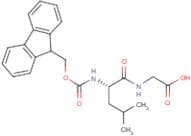
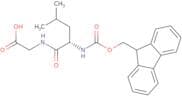
![Glycine, N-[N-[(9H-fluoren-9-ylmethoxy)carbonyl]-L-leucyl]-](/_next/image/?url=https%3A%2Fstatic.cymitquimica.com%2Fcas-image%2Fthumb-webp%2F339016-glycine-n-n-9h-fluoren-9-ylmethoxy-carbonyl-l-leucyl.webp&w=3840&q=75)
CAS 82007-05-4
:Glycine, N-[N-[(9H-fluoren-9-ylmethoxy)carbonyl]-L-leucyl]-
Description:
Glycine, N-[N-[(9H-fluoren-9-ylmethoxy)carbonyl]-L-leucyl]- is a peptide derivative that features a glycine moiety linked to a leucine residue, with a protective fluorenylmethoxycarbonyl (Fmoc) group. This compound is characterized by its role in peptide synthesis, particularly in solid-phase peptide synthesis, where the Fmoc group serves as a temporary protecting group for the amino group. The presence of the fluorenylmethoxycarbonyl group enhances the stability and solubility of the peptide during synthesis and purification processes. The structure of this compound allows for specific interactions in biological systems, making it relevant in research and pharmaceutical applications. Additionally, the compound is typically white to off-white in appearance and is soluble in organic solvents, which is advantageous for various laboratory techniques. Its molecular structure contributes to its functionality in biochemistry, particularly in the design of peptide-based drugs and in studies of protein interactions. As with many peptide derivatives, it is essential to handle this compound with care, following appropriate safety protocols.
Formula:C23H26N2O5
Sort by
Purity (%)
0
100
|
0
|
50
|
90
|
95
|
100
Found 4 products.
Fmoc-Leu-Gly-OH
CAS:Fmoc-Leu-Gly can self-assemble forming ultrathin hydrogel membranes.Formula:C23H26N2O5Purity:99.68%Color and Shape:WhiteMolecular weight:410.47GLYCINE, N-[N-[(9H-FLUOREN-9-YLMETHOXY)CARBONYL]-L-LEUCYL]-
CAS:Formula:C23H26N2O5Purity:95%Color and Shape:SolidMolecular weight:410.4629Fmoc-Leu-Gly-OH
CAS:Fmoc-Leu-Gly-OH is a dipeptide that is reversibly soluble in water and organic solvents. It has been found to be stable at millimeter and nanometer scales, which makes it suitable for use as a hydrogel or fiber. Fmoc-Leu-Gly-OH has also been shown to form membranes of variable thickness (from micrometers to nanometers) that are sensitive to pH changes. This means that the membrane can be used for sensing pH levels in a variety of environments. Dipeptides are amphiphiles, meaning they have both hydrophilic and lipophilic properties. This makes them useful for forming self-assembled structures, such as hydrogels and membranes, that are capable of transporting water molecules through the structure.Formula:C23H26N2O5Purity:Min. 95%Color and Shape:PowderMolecular weight:410.46 g/mol

![GLYCINE, N-[N-[(9H-FLUOREN-9-YLMETHOXY)CARBONYL]-L-LEUCYL]-](/_next/image/?url=https%3A%2Fstatic.cymitquimica.com%2Fproducts%2FIN%2Fthumb%2FDA004YUQ.jpg&w=3840&q=75)