CAS 82594-80-7
:1-Triphenylmethyl-4-methylimidazole
Description:
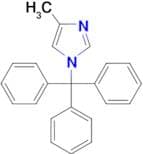
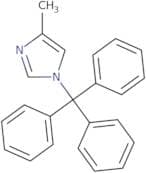
1-Triphenylmethyl-4-methylimidazole, with the CAS number 82594-80-7, is an organic compound characterized by its unique structure that includes a triphenylmethyl group and a methyl-substituted imidazole ring. This compound typically exhibits properties such as being a solid at room temperature, with a relatively high melting point due to the presence of multiple aromatic rings that contribute to its stability and rigidity. It is often used in various chemical applications, including as a reagent in organic synthesis and as a potential ligand in coordination chemistry. The imidazole moiety can participate in hydrogen bonding and coordination with metal ions, making it useful in catalysis and material science. Additionally, the compound may display interesting photophysical properties, which can be exploited in the development of fluorescent materials or sensors. Its solubility can vary depending on the solvent, often being more soluble in organic solvents than in water. Overall, 1-Triphenylmethyl-4-methylimidazole is a versatile compound with applications in both academic research and industrial processes.
Formula:C23H20N2
InChI:InChI=1/C23H20N2/c1-19-17-25(18-24-19)23(20-11-5-2-6-12-20,21-13-7-3-8-14-21)22-15-9-4-10-16-22/h2-18H,1H3
SMILES:Cc1cn(cn1)C(c1ccccc1)(c1ccccc1)c1ccccc1
Synonyms:- 4-Methyl-1-trityl-1H-imidazole
- 4-Methyl-1-tritylimidazole
Sort by
Purity (%)
0
100
|
0
|
50
|
90
|
95
|
100
Found 2 products.
4-methyl-1-trityl-1H-imidazole
CAS:Purity:95.0%Color and Shape:SolidMolecular weight:324.4270019531251-Triphenylmethyl-4-methylimidazole
CAS:Controlled Product1-Triphenylmethyl-4-methylimidazole (1MPIm) is a biaryl compound that can be used in the synthesis of organic compounds. 1MPIm reacts with aryl chlorides and catalysts to form biaryl compounds. This reaction is known as the Suzuki coupling, which is catalyzed by palladium or nickel. The use of 1MPIm is advantageous because it leads to high yields with good steric properties and few side reactions. It has been shown to be effective for the synthesis of many different types of compounds, including those containing an arylboronic acid group.Formula:C23H20N2Purity:Min. 95%Molecular weight:324.42 g/mol