CAS 827614-46-0
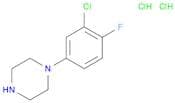
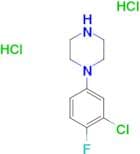
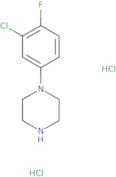
:Piperazine,1-(3-chloro-4-fluorophenyl)-, hydrochloride (1:2)
Description:
Piperazine, 1-(3-chloro-4-fluorophenyl)-, hydrochloride (1:2) is a chemical compound characterized by its piperazine core, which is a six-membered heterocyclic amine. This compound features a chloro and a fluoro substituent on the phenyl ring, contributing to its unique chemical properties and potential biological activity. The hydrochloride form indicates that it is a salt, which typically enhances its solubility in water and may influence its pharmacokinetic properties. Piperazine derivatives are often studied for their pharmacological effects, including potential applications in treating various medical conditions. The presence of halogen atoms like chlorine and fluorine can enhance lipophilicity and alter the compound's interaction with biological targets. As with many piperazine derivatives, this compound may exhibit activity as an antagonist or agonist at certain receptors, making it of interest in medicinal chemistry. Safety and handling precautions should be observed, as with all chemical substances, due to potential toxicity or reactivity.
Formula:C10H12ClFN2ClH
Synonyms:- Piperazine,1-(3-chloro-4-fluorophenyl)-, dihydrochloride (9CI)
Sort by
Purity (%)
0
100
|
0
|
50
|
90
|
95
|
100
Found 3 products.
1-(3-CHLORO-4-FLUOROPHENYL)-PIPERAZINE DIHYDROCHLORIDE
CAS:Formula:C10H14Cl3FN2Purity:97%Molecular weight:287.5891-(3-Chloro-4-fluorophenyl)piperazine dihydrochloride
CAS:Purity:98%Color and Shape:SolidMolecular weight:287.57998657226561-(3-Chloro-4-fluorophenyl)piperazine dihydrochloride
CAS:Controlled Product1-(3-Chloro-4-fluorophenyl)piperazine dihydrochloride (1CFP) is a fine chemical that has been used as a building block for research chemicals, reagent, and speciality chemical. 1CFP is also a versatile building block that can be used in the synthesis of a wide range of complex compounds. This compound is an intermediate in the synthesis of many other pharmaceuticals. 1CFP has been shown to be useful as a reaction component in the synthesis of new drugs and scaffolds. It is also useful to study DNA binding and protein interactions.
Formula:C10H12ClFN2•(HCl)2Purity:Min. 95%Color and Shape:PowderMolecular weight:287.59 g/molRef: 3D-FC71132
Discontinued product