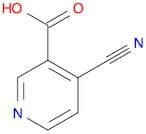
CAS 827616-51-3
:3-Pyridinecarboxylicacid, 4-cyano-
Description:
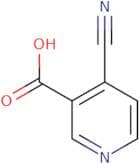
3-Pyridinecarboxylic acid, 4-cyano- is an organic compound characterized by its pyridine ring structure, which is a six-membered aromatic ring containing one nitrogen atom. This compound features a carboxylic acid functional group (-COOH) at the 3-position and a cyano group (-CN) at the 4-position of the pyridine ring. The presence of these functional groups imparts distinct chemical properties, such as acidity due to the carboxylic acid and potential reactivity associated with the cyano group. The compound is typically a solid at room temperature and may exhibit polar characteristics due to the functional groups, influencing its solubility in various solvents. It can participate in various chemical reactions, including nucleophilic substitutions and condensation reactions, making it useful in synthetic organic chemistry. Additionally, its derivatives may have applications in pharmaceuticals, agrochemicals, and materials science. As with many pyridine derivatives, it may also exhibit biological activity, warranting further investigation into its potential uses in medicinal chemistry.
Formula:C7H4N2O2
Synonyms:- 3-Pyridinecarboxylic acid, 4-cyano-
- 4-Cyano-3-pyridinecarboxylic acid
- 4-Cyanopyridine-3-Carboxylic Acid
- 4-cyano-3-Pyridine carbocylic acid
- 4-cyanonicotinic acid
Sort by
Purity (%)
0
100
|
0
|
50
|
90
|
95
|
100
Found 4 products.
4-Cyano-3-pyridinecarboxylic acid
CAS:4-Cyano-3-pyridinecarboxylic acid
Molecular weight:148.11886g/mol4-Cyanopyridine-3-carboxylic acid
CAS:4-Cyanopyridine-3-carboxylic acid is a vanadium compound that has been shown to be an effective catalyst for the oxidation of alcohols to carboxylic acids. It has been used in the synthesis of esters and amides from alcohols and ammonia. 4-Cyanopyridine-3-carboxylic acid is more reactive than other catalysts, such as iron or copper, due to its high nucleophilicity and low gas solubility. This makes it a good candidate for use in the gaseous phase or gas phase. The metal center of 4-cyanopyridine-3-carboxylic acid is protonated by water molecules, which then act as electron acceptors. This mechanism leads to the formation of H+ ions, which act as an acid catalyst. One proposed mechanism for this reaction is the addition of hydroxide ion (OH-) to form a carbanion intermediateFormula:C7H4N2O2Purity:Min. 95%Molecular weight:148.12 g/mol