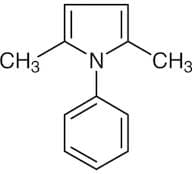
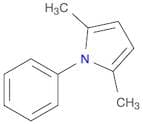
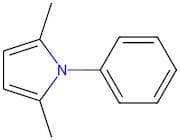
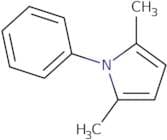
CAS 83-24-9
:2,5-Dimethyl-1-phenylpyrrole
- 1-Phenyl-2,5-dimethylpyrrole
- 1-cyclohexyl-2,5-dimethyl-1H-pyrrole
- 1H-Pyrrole, 2,5-dimethyl-1-phenyl-
- 2,5-Dimethyl-1-Phenylpyrrolidine
- 2,5-Dimethyl-1-phenyl-1H-pyrrole
- N-Phenyl-2,5-dimethylpyrrole
- Nsc 163170
- Pyrrole, 2,5-dimethyl-1-phenyl-
- Pyrrole, 2,5-dimethyl-1-phenyl- (8CI)
- 2,5-Dimethyl-1-phenylpyrrole
2,5-Dimethyl-1-phenylpyrrole
CAS:Formula:C12H13NPurity:>98.0%(GC)Color and Shape:Light yellow to Brown to Dark green powder to crystalMolecular weight:171.242,5-Dimethyl-1-phenylpyrrole
CAS:Formula:C12H13NPurity:98%Color and Shape:SolidMolecular weight:171.23832,5-Dimethyl-1-phenyl-1H-pyrrole
CAS:2,5-Dimethyl-1-phenyl-1H-pyrrolePurity:98%Molecular weight:171.23832g/mol2,5-Dimethyl-1-phenylpyrrole
CAS:Formula:C12H13NPurity:98%Color and Shape:SolidMolecular weight:171.2432,5-Dimethyl-1-phenylpyrrole
CAS:2,5-Dimethyl-1-phenylpyrrole is a colorless liquid that has been shown to undergo condensation reactions with chloride or nitro groups. 2,5-Dimethyl-1-phenylpyrrole can be synthesized by the reaction of phenylacetaldehyde and formaldehyde in the presence of an acid catalyst. This molecule also reacts with amines and provides a chromatographic technique for separating enantiomers. The functional groups present in this compound are electrophilic and nucleophilic, which are thermodynamically favorable. 2,5-Dimethyl-1-phenylpyrrole has been shown to react with ammonia gas at elevated temperatures, forming a molecule with nitro group. It has also been shown that 2,5-Dimethyl-1-phenylpyrrole can be used as an organic reagent for the synthesis of other molecules containing nitro group at room temperature.
Purity:Min. 95%