CAS 83-32-9
:Acenaphthene
Description:
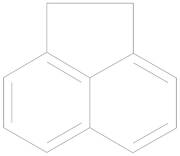
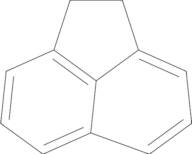
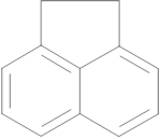
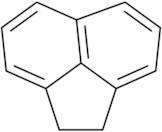
Acenaphthene is a polycyclic aromatic hydrocarbon (PAH) characterized by its fused bicyclic structure, consisting of a naphthalene ring with an additional five-membered carbon ring. It appears as a colorless to pale yellow solid at room temperature and has a distinctive aromatic odor. Acenaphthene is relatively insoluble in water but soluble in organic solvents such as benzene, toluene, and ether. Its melting point is typically around 81-83°C, while its boiling point is approximately 280°C. This compound is known for its stability and resistance to oxidation, making it useful in various applications, including as a precursor in the synthesis of dyes, pharmaceuticals, and other organic compounds. Acenaphthene is also found in coal tar and can be produced during the incomplete combustion of organic materials. While it has some industrial uses, it is important to handle acenaphthene with care due to its potential environmental and health impacts, as many PAHs are known to be carcinogenic.
Formula:C12H10
InChI:InChI=1S/C12H10/c1-3-9-4-2-6-11-8-7-10(5-1)12(9)11/h1-6H,7-8H2
InChI key:InChIKey=CWRYPZZKDGJXCA-UHFFFAOYSA-N
SMILES:C12=C3CCC1=CC=CC2=CC=C3
Synonyms:- 1,2-Dihydroacenaphthylene
- 1,8-Dihydroacenaphthalene
- 1,8-Ethylenenaphthalene
- Acenafteno
- Acenaphtene
- Acenaphthen
- Acenaphthylene, 1,2-dihydro-
- Ai3-00128
- Ccris 5951
- Ethene - Naphthalene (1:1)
- Ethylenenaphthalene
- Hsdb 2659
- Naphthyleneethylene
- Nsc 7657
- peri-Ethylenenaphthalene
- See more synonyms
Sort by
Purity (%)
0
100
|
0
|
50
|
90
|
95
|
100
Acenaphthene 100 µg/mL in Acetonitrile
CAS:Formula:C12H10Color and Shape:Single SolutionMolecular weight:154.21EPA Method 8270 Calibration Mixture 500-1000 µg/mL in Dichloromethane
CAS:Controlled Product- 100-01-6
- 100-02-7
- 100-25-4
- 100-51-6
- 101-55-3
- 103-23-1
- 103-33-3
- 105-67-9
- 106-44-5
- 106-46-7
- 106-47-8
- 108-39-4
- 108-60-1
- 108-95-2
- 110-86-1
- 111-44-4
- 111-91-1
- 117-81-7
- 117-84-0
- 118-74-1
- 120-12-7
- 120-82-1
- 120-83-2
- 121-14-2
- 122-39-4
- 129-00-0
- 131-11-3
- 132-64-9
- 191-24-2
- 193-39-5
- 205-99-2
- 206-44-0
- 207-08-9
- 208-96-8
- 218-01-9
- 50-32-8
- 51-28-5
- 528-29-0
- 53-70-3
- 534-52-1
- 541-73-1
- 56-55-3
- 58-90-2
- 59-50-7
- 606-20-2
- 62-53-3
- 62-75-9
- 621-64-7
- 67-72-1
- 7005-72-3
- 77-47-4
- 78-59-1
- 83-32-9
- 84-66-2
- 84-74-2
- 85-01-8
- 85-68-7
- 86-73-7
- 86-74-8
- 87-68-3
- 87-86-5
- 88-06-2
- 88-74-4
- 88-75-5
- 90-12-0
- 91-20-3
- 91-57-6
- 91-58-7
- 935-95-5
- 95-48-7
- 95-50-1
- 95-57-8
- 95-95-4
- 98-95-3
- 99-09-2
- 99-65-0
Formula:C6H3Cl3Color and Shape:MixtureMolecular weight:181.45Acenaphthene
CAS:Purity:99.0%Color and Shape:Solid, White to almost white powderMolecular weight:154.21200561523438Acenaphthene
CAS:<p>Acenaphthylene is a natural compound that has anti-inflammatory activity. It has been shown to inhibit the growth of skin cancer cells and wild-type strains of Escherichia coli. Acenaphthylene is synthesized by thermal degradation of acenaphthene and can be found in wastewater. Acenaphthylene can be extracted from these samples using solid phase microextraction (SPME). Acenaphthene can also be used as an indicator for the presence of other compounds in a reaction solution or analytical method. Acenaphthylene reacts with hydrogen peroxide to form a fluorescent derivative, which can be detected using UV light. The injection solution used for this reaction is acetone, methanol, and distilled water.</p>Formula:C12H10Purity:Min. 99 Area-%Color and Shape:PowderMolecular weight:154.21 g/molAcenaphthene (1,2-Dihydro Acenaphthylene)
CAS:<p>Applications Polycyclic aromatic hydrocarbons as carcinogenic agents.<br> Not a dangerous good if item is equal to or less than 1g/ml and there is less than 100g/ml in the package<br>References Hansen, B., et al.: Environ. Toxicol. Chem., 18, 772 (1999), Czub, G., et al.: Environ. Sci. Technol., 38, 2406 (2004),<br></p>Formula:C12H10Color and Shape:White To Off-WhiteMolecular weight:154.21